Dropshipping, Print on Demand & Affiliate Marketing for Beginners 2026 Guide
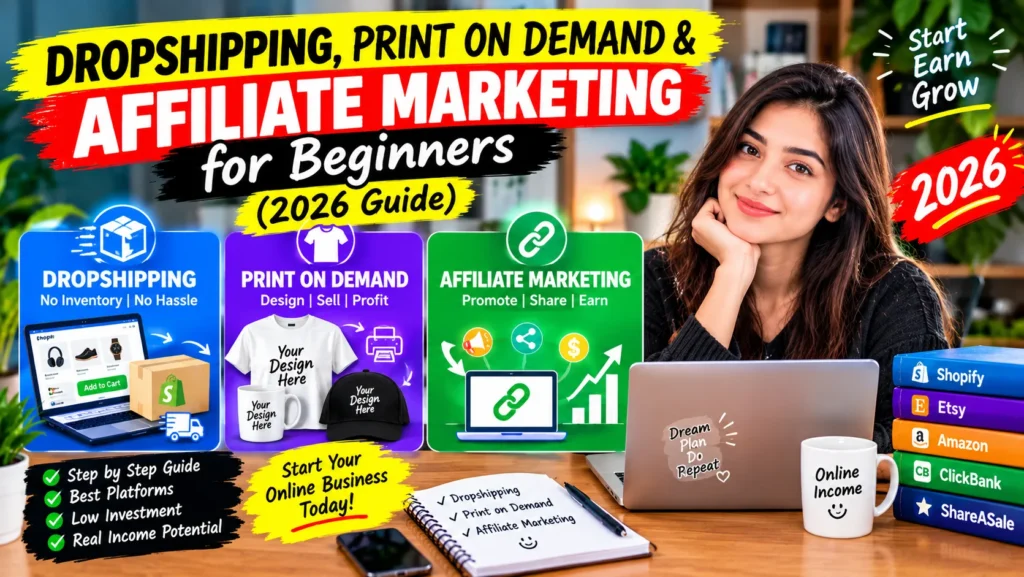
Dropshipping, Print on Demand, and Affiliate Marketing For Beginners – Which Route Actually is Best for you? If you’re totally new to earning online I know exactly what you’re feeling right now.
You go on YouTube late at night and go to search for how to make money online and 1000 video’s come up. One guy in a rented Lamborghini says dropshipping is dead, another guy with a giant microphone says print on demand is the easiest and the third says affiliate marketing made him 10k while he was sleeping.
You watch 10 videos, you’ve got 20 more to watch and you never get to them at the end because you’re overwhelmed.
I’ve been there. Now allow me to simply describe all 3 techniques dropshipping, print on demand and associate in human language. No hype, no pretend screenshot, no “turn into a millionaire in 7 days” garbage.
All three work. I have seen friends making full-time income from all three in Pakistan and outside. But they work DIFFERENTLY. They need different skills, different patience, and different kind of daily work. If you pick the wrong one for your nature, you will quit in 60 days and say “online business is scam.” It’s not scam, you just picked the wrong game for you.
Dropshipping, Print on Demand & Affiliate Marketing for Beginners 2026 Guide
1. Dropshipping – What It Really Is When The Hype Is Removed
Let me explain it like you are 15 years old. You make an online store on Shopify. You find a product let’s say a car vacuum cleaner that costs $15 on Ali Express. You list it on your store for $40 with better photos and a better description. You don’t buy it.
Now a customer comes to your store and buys it for $40. You take that order, you go to your supplier, you pay him $15 and you give him your customer’s address. Your supplier packs it and ships it directly to your customer. You never touch the product. You keep the $25 difference.
That’s it. That’s the whole model. Why beginners love it?
- First, low cost to start. You don’t need to buy 100 pieces and keep them in your room. Just pay for domain, Shopify, and some samples. You can start with $100-$150.
- Second, you can test fast. If a product doesn’t sell, you remove it in 5 minutes and test another one. No loss of inventory.
- Third, you can run it from anywhere. All you need is a laptop and internet.
- But here’s the part gurus don’t tell you on Instagram.
- Dropshipping is NOT passive income. It is a full customer service business.
Your profit margins are thin because 1000 other people are selling the exact same product. You are competing on price. Shipping is slow if you use cheap suppliers from China, it takes 14 to 28 days to reach USA or Europe, and customers get angry because they are used to Amazon delivering next day. If your supplier sends bad quality, the customer blames YOU, not the supplier. Your store gets the 1-star review.
And then there’s ads. This is where 90% beginners fail. You WILL lose money on ads in the first month. That’s normal. You have to think of it as learning fees, not loss.
Mistakes in dropshipping:
They never order a sample. They just copy AliExpress photos and put them on their store. Then customer gets something totally different. Always order the sample yourself. Check quality with your own hands.
They try to sell everything – kitchen items, pet items, beauty items all in one store. That never works. Pick ONE niche. One.
They price too low. If you buy for $10 and sell for $15, after Shopify fees, ad cost, you are in loss. You need at least 2.5x to 3x markup to survive.
2. Print on Demand – Best For Creative People
Print on Demand, or POD, is technically dropshipping too, but it’s a different game because you sell YOUR design.
You make a design could be a funny quote for nurses, a joke that only cat dads understand, a design that says “Proud Sindhi” or “Shehzada of Lahore”, or a design for truck drivers. You upload that design to a site like Printful or Printify.
So difference? In normal dropshipping you sell someone else’s product. In POD you sell your own design on someone else’s blank product. That means you don’t compete on price, you compete on creativity.
Why people who are creative love POD: No inventory risk at all. You pay zero until someone orders. You can launch 10 new designs in one evening. You actually build a brand – people start recognizing your style. And your designs protect you. No one can easily copy your exact humor.
But let’s be real about the downside. Margins are low. Example a t-shirt costs you $12 to produce, you sell for $24.99, you make about $12 before platform fees and ads. Not huge. You also can’t check quality before it goes to customer. And shipping is still not fast – 5 to 10 days usually.
What sells and what doesn’t in 2026? Generic stuff is dead. “Be Positive”, “Dream Big”, “Stay Strong” – this is everywhere, nobody buys it anymore. What sells is super specific, niche stuff. Inside jokes.
A shirt that says “Night Shift Nurse Powered by Coffee, Sarcasm and Scrubs” will sell 10x more than “I love nursing”. A mug that says “My Shiba Inu Thinks I’m Cool” will sell like crazy in that dog community. Designs for a specific city, specific profession, specific hobby, seasonal – Ramadan, Eid, Halloween – those work.
The most successful POD sellers I know don’t design for everyone. They design for ONE specific community and become famous in that community.
3. Affiliate Marketing – Easiest To Understand, Hardest To Actually Do Well
This is the simplest model to understand.
You recommend someone else’s product using your special tracking link. If someone buys from your link, you get a commission. You don’t handle product. No shipping. No returns. No angry customers messaging you “where is my order”. Your only job is content and trust.
You join an affiliate program – Amazon Associates, Share A Sale, Click Bank, or a brand’s own program. They give you a unique link. You make content around that product like a review, a comparison video, a tutorial like “Best Budget Mic for New YouTubers in Pakistan 2026”. You put your link in description. People click, they buy, you get commission.
How much commission? Physical products from Amazon – 1% to 10%. Not much.
Digital products, courses – 30% to 70%, sometimes more.
Software and apps – 20% to 30% every month recurring. This is gold.
Also check cookie duration. Amazon gives you only 24 hours after someone clicks. Some software companies give you 60-90 days. Now the hard truth.
Everyone thinks you just spam affiliate links on Facebook groups and make money. That NEVER works. Nobody clicks random links. And it’s slow. Very slow at start. If you start a blog today and post 2 articles a week, you might see your first commission after 3-6 months. To make consistent $500-$1000 a month, it usually takes 1 to 2 years of consistent content. It’s boring, it’s slow, but it compounds. One good article can make you money for 2 years.
So Which One Should YOU Start? Let’s Be Practical
- Don’t ask “which is best?” Ask “which fits me?”
- Ask yourself – how do you like to spend your day?
- If you love marketing, you like testing products, you like running ads, you don’t mind replying to customer messages – go for dropshipping. It will teach you e-commerce faster than anything.
- If you are creative, you love Canva, you have funny ideas, you love designing, and you hate dealing with inventory and suppliers – go for print on demand.
- If you love writing, making videos, explaining things, teaching, and you absolutely HATE customer support and shipping problems – affiliate marketing is made for you.
- If you want lowest risk and zero investment – start with affiliate marketing. Learn how to make content. Build an audience. Later, you can launch your own POD merch for that same audience. Many smart people do this combination.
- Many successful people mix them. For example, a POD store owner also puts affiliate links for related products in his thank-you emails. A blogger who does affiliate also launches his own small dropshipping product later.
Also Check; Memecoin Airdrop Guide 2026: How to Find Real Rewards Safely
How to Start Each One – No Theory, Just Steps
If you pick Dropshipping:
Pick ONE niche you understand. Don’t sell everything. Check Google Trends if people are actually searching for it. Find a good supplier on Spocket or Zendrop and ORDER a sample to your home. Check quality. Make a simple Shopify store – use free theme, don’t waste 2 weeks on logo. Keep profit margins high – try to sell at 2.5x your cost. Start testing ads with $5-$10 a day, not $100. Your goal first month is learning, not profit.
If you pick Print on Demand:
Pick ONE specific audience you know well – like gym girls, medical students, truck drivers, cat moms, fishermen. Make 10 designs around their inside jokes and problems. Use Canva, it’s enough. Connect to Printful or Printify and order one sample for yourself to check print quality. Make your product description tell a story about the design, not just “cotton t-shirt”. Market where that audience hangs out – Pinterest, TikTok, niche Facebook groups. Don’t run ads on day one.
If you pick Affiliate Marketing:
Pick ONE topic you can talk about for 2 years without getting bored – like pets, budgeting, tech, books, fitness. Pick ONE platform – blog, YouTube, or TikTok – and stick to it. Don’t be everywhere. Join 2-3 affiliate programs related to your topic. Make HELPFUL content that solves problems, not just “buy this, buy this”. For example, instead of “Best Laptop”, write “Best Laptop for Medical Students Under $600 – Tested”. Be patient. Give it at least 6 months.
Frequently Asked Questions
Which is the easiest online business for a complete beginner with no money?
Affiliate marketing. You need zero investment, no product, no inventory. You can start with just your phone and free platforms like TikTok or Blogger. But easy to start doesn’t mean easy to earn. You need months to build trust. If you have a little money, POD is also very low risk.
How much money do I actually need to start dropshipping in 2026?
You can technically start with $100 for domain and Shopify basic plan. But realistically, keep $300-$500. Because you need to buy samples and you need some ad budget to test. If you go in with $20 and expect sales, you’ll be disappointed.
Is print on demand still profitable or is it too crowded?
It’s profitable but only for niche designs. Generic motivational quotes are dead, too crowded. But specific community designs are still selling very well. People pay for designs that feel made FOR them. Market is still growing fast.
How long before I see my first sale?
Dropshipping – you can get first sale in 2-7 days if your ads are okay, but profit takes 1-3 months. POD – first sale usually in 2-4 weeks if your designs are good and niche is right. Affiliate – first commission usually takes 3-6 months because you need audience first.
Which one creates the most valuable long term asset?
All three can be sold later. A profitable dropshipping store can be sold. A POD brand with loyal customers can be sold for good money. An affiliate blog that makes $1000 a month can be sold for $30k-$40k. But affiliate is a bit harder to sell because it depends on your personal trust with audience. POD brands usually have highest loyalty if you do it right.
Conclusion
Look, there is no magic model that will make you rich in 7 days. If someone tells you that, he’s trying to sell you his course.
All three models are real. All three need work. Dropshipping needs hustle and ad testing. POD needs creativity and consistency. Affiliate needs patience and trust. The best model for you is the one that matches your personality and that you can stick to for 90 days.
My advice? Pick ONE. Just one. Give it 90 days of real action. Not watching tutorials, real action. 1 hour a day. You will learn more in those 90 days than 1 year of overthinking.
And don’t try to be perfect on day one. Launch ugly. Improve later.

One Comment