Bitcoin Layer 2 Networks in 2026: Scaling Bitcoin Explained
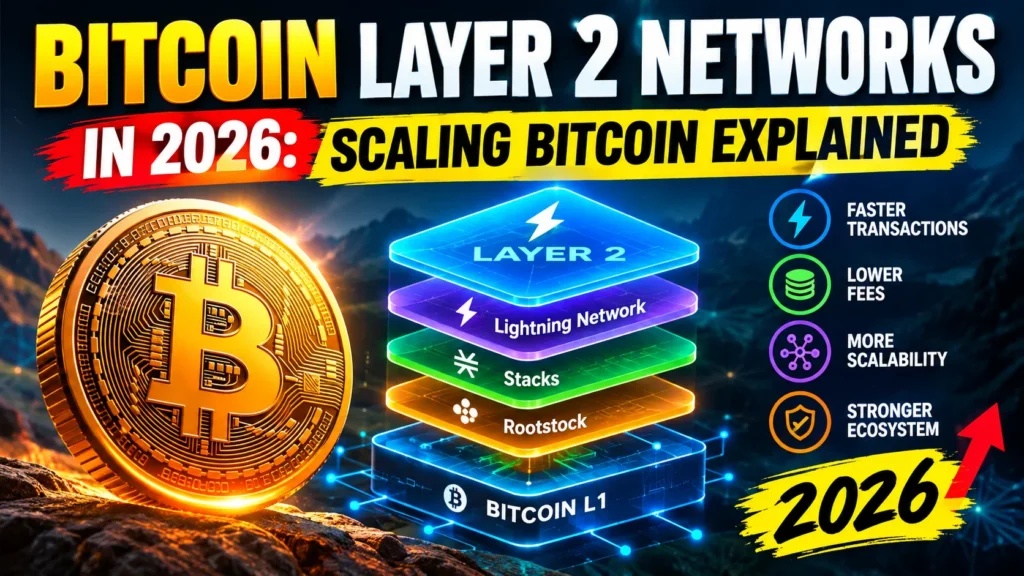
Bitcoin Layer 2 Networks in 2026. Bitcoin is safest chain we have. No one ever hacked it. It never went offline. But god it’s slow. For years we all just said “that’s okay, that’s the price for decentralization”. In 2026 that argument just doesn’t fly anymore.
Bitcoin Layer 2 networks they are not just whitepapers anymore. They are live. With real BTC inside. Real people actually using them. I checked last week, more than 75 projects now, all saying they will scale Bitcoin, make your BTC earn something instead of just sitting cold in a wallet.
Some actually delivered. Bitcoin Layer 2 Networks in 2026. Some shut down. One got exploited for almost 4000 BTC. So question changed. It’s not can Bitcoin scale. It’s which one would you trust with YOUR coins? That’s the real question.
Bitcoin Layer 2 Networks in 2026: What Is a Bitcoin Layer 2 Network?
It’s a layer built on top of Bitcoin. Bitcoin L1 does like 7 transactions per second. You can’t build a lending app or DEX directly on it, script is too limited, on purpose. So instead of trying to change Bitcoin which takes years people built around it.
You do all the busy work off-chain on L2, and Bitcoin is like the final judge. Settlement, security, that’s Bitcoin. Some L2s just want payments cheap. Some want full smart contracts like Ethereum. Some want to be super trustless, some say we will be a bit centralized but fast. No perfect answer, just different tradeoffs.
How Bitcoin Layer 2 Networks Work?
The Core Approaches
There are 3 main ways people building this:
- State channels: Me and you lock BTC in a 2-of-2 multisig on Bitcoin. That’s one on-chain tx. After that we can send money to each other thousands of times off-chain, instant, almost free. Only final balance hits chain again. That’s how Lightning works. Super fast but you need to lock money and stay online to get paid, which is annoying.
- Sidechains: Separate blockchain running next to Bitcoin. You lock BTC on main chain, you get IOU token on sidechain. You can do whatever you want there because sidechain has own rules. Flexible, but now you’re trusting that sidechain team, its federation, its miners.
- Rollups and BitVM-based systems: New thing. Instead of having own security, they try to borrow Bitcoin’s security. BitVM came in 2024 and changed everything lets you verify complex stuff on Bitcoin without changing Bitcoin. Still early but this is where smartest devs are going.
Every design picks two out of three speed, security, decentralization. You never get all three.
The Trust Spectrum
This part boring but please don’t skip. This is where people lose money. Who holds your actual BTC?
- On one side Lightning your BTC is in Bitcoin contract you control. Even if every Lightning company disappears tomorrow, you can go back to L1 and claim your BTC yourself.
- Other side federated sidechains. Like 10-15 companies hold keys to vault where real BTC lives. They hold REAL BTC. What you have on sidechain is just promise. If they get hacked, if they collude, if they push bad code your promise is zero.
- Before you look at APY, look who holds keys.
The Major Bitcoin Layer 2 Networks in 2026
Lightning Network
OG. Still king for payments.
- Public stats look dead capacity down, nodes down, channels down. Bitcoin Layer 2 Networks in 2026. I saw that graph and thought oh man Lightning dying?
- Then I asked a guy who runs routing for an exchange. He laughed. Said “we all moved to private channels bro”.
- All big players exchanges, payment apps run private channels that don’t show on explorer.
- Private channels now hold MORE BTC than public ones. Bitcoin Layer 2 Networks in 2026. So explorer looks dead but real world volume is still there more than $1.1B a month in payments.
- Usage just changed. Bitcoin Layer 2 Networks in 2026. Less hobby nodes in bedroom, more business settlement. And new thing USDT on Lightning via Taproot Assets.
- People using Lightning not even for BTC, but for dollars because it’s cheapest rail.
Key limitation: It’s payment only. You can’t build DeFi on it. And liquidity management, channel backup still nightmare for normal users.
Stacks
Stacks been trying to be “Bitcoin + smart contracts” for years. This year it finally started clicking.
They have weird consensus called Proof of Transfer miners burn BTC to mine Stacks blocks. That’s how they link to Bitcoin.
2026 was actually good for them. They launched real Bitcoin staking you timelock actual BTC on Bitcoin L1, no wrapping, no bridge, you keep control, earn yield in BTC. That’s big difference from fake staking. Second, USDC went live natively, so finally real dollar liquidity, not some wrapped crap. Bitcoin Layer 2 Networks in 2026. They talking about 100x throughput and building for AI agents to trade on chain.
Key limitation: It’s not Bitcoin. Has STX token, own chain, own consensus. Anchored to Bitcoin but not same security. Don’t confuse.
Also Check: Passive Income Ideas 2026: 12 Smart Side Hustle Ideas That Work
Rootstock (RSK)
Rootstock old, since 2018. In crypto that’s like 100 years. EVM compatible, so Ethereum devs can just copy paste app to Bitcoin. Merge-mines with Bitcoin miners.
This year they rebuilt a lot. Vetiver upgrade was prep for Union Bridge new bridge using BitVMX that is way less trusted than old federation. Bitcoin Layer 2 Networks in 2026. And they launched Atlas, which is finally a bridge UI that doesn’t make you want to throw laptop away.
Key limitation: Still federated right now. Federation controls BTC that backs RBTC. You trust federation.
Liquid Network
Liquid was Block stream project for big boys exchanges, institutions. Fast blocks, confidential.
Then 2026 disaster. Bug in Elements code. Not private key leak, not phishing pure logic bug in how proofs verified. Bitcoin Layer 2 Networks in 2026. Someone minted L-BTC out of thin air with no backing and drained about 3,996 BTC from federation wallet. They had to halt chain. Bitcoin Layer 2 Networks in 2026. Most funds returned later but trust gone.
Key limitation: Federation again. Same small group holds all real BTC. One bug in check and whole vault empty.
The State of Bitcoin Layer 2 in 2026: Key Trends
From Narrative to Fundamentals
Last cycle you could raise $10M with deck saying “Bitcoin L2”. Now nobody cares.
All Bitcoin L2s combined TVL is around $2.1B as of August 2026. That’s less than 0.2% of Bitcoin market cap. Ethereum L2s have like 11% of ETH market cap. We are tiny.
That tells you market is brutal now. Money not coming unless you have real users, real fees. Botanix everyone hyped it last year, even I wrote about it shut down in 2026. No users, dead.
Now it’s fundamentals. How many daily users? Is liquidity staying or just farming and dumping? Are devs shipping or just tweeting?
The Shift to Bitcoin-Native Finance
This trend I like most this year.
People sick of wrapping BTC, bridging to some random chain, trusting multisig. New designs let BTC stay on Bitcoin and still earn.
Stacks staking BTC never leaves L1, time locked there. Babylon you stake BTC to secure other PoS chains, earn yield from that. Babylon hit $560M TVL by mid 2026 just doing that.
Bitcoiners want yield but don’t want to give up custody. Finally options that give both.
Security Incidents Force a Reckoning
Liquid hack should be taught in every crypto course.
- Crypto didn’t break. Authorization check broke. Code checked signature right but forgot to check “is this guy allowed to mint?” So attacker didn’t break cryptography, just walked through open door.
- Perfect crypto means nothing if permission logic is trash.
- Every L2 adds new attack surface. You can’t just say Bitcoin secure so we secure. You have to check bridge, federation software, mint logic, everything.
Benefits and Limitations of Bitcoin Layer 2 Networks
Benefits
| Benefit | Explanation |
|---|---|
| Lower fees | On L2 you pay cents even when L1 fee is $30. Big difference. |
| Faster settlement | From 1 hour wait to 1-2 seconds. Feels like real money. |
| New use cases | DeFi, stable coins, lending things Bitcoin alone could never do. |
| BTC yield | Your BTC sitting idle can finally earn something. |
Limitations and Risks
| Limitation | Explanation |
|---|---|
| Trust assumptions | Most L2s still make you trust federation, bridge, sequencer. |
| Complexity | Bridging, channels, backups — still too confusing for normal person. |
| Security risks | More code = more bugs. Even audited code got exploited this year. |
| Fragmentation | 75+ L2s means liquidity split into tiny puddles everywhere. |
| Regulatory uncertainty | Is staking income? Is L2 token security? No clear answer yet. |
Practical Use Cases for Bitcoin Layer 2
1. Fast, Low-Cost Payments
Lightning, that’s it. If you want to pay with Bitcoin, only one that feels ready. I sent $20 to my cousin last month over Lightning 2 sec, fee 1 sat. Try that on mainnet when mempool full, impossible.
2. Bitcoin-Backed Lending
On Rootstock and Stacks you lock BTC, borrow stablecoins. You get cash without selling BTC, so no tax event. Good in bull. But if BTC dumps 20% in day, you get liquidated fast. I saw friends get wiped.
3. Earning Yield on Bitcoin
Stacks and Babylon lock BTC, earn yield. For long term holders who just hodling since 2021, tempting. But lockup, smart contract risk, slashing real.
4. Stablecoin Access
USDT and USDC now on Bitcoin L2s. Big deal actually. You can stay in Bitcoin world but transact in dollars, no volatility headache for daily stuff.
Common Mistakes to Avoid
- Ignoring the trust model. Who holds real BTC? What if bridge dies? If you can’t answer, don’t deposit. Simple.
- Chasing yields without understanding risks. 25% APY on BTC? That yield comes from somewhere risky probably inflationary token or leverage. Check before you ape.
- Not testing with small amounts first. Send $10 first. Does it land? Can you get it back? Then send bigger. Never send full stack first time. Never.
- Assuming all L2s are equally secure. 7 year old payment network vs 3 month old sidechain not same risk. Not even close. Liquid proved even old ones can blow up.
- Overlooking tax implications. Bridging, staking, yield in most countries taxable. That yield might come with tax bill later. Ask accountant, not influencer.
The Road Ahead: What to Watch in 2026 and Beyond
Four things will decide who wins:
- Covenants: OP_CTV, OP_CAT upgrades that give Bitcoin a bit more power. If they activate, we can build way safer L2s. Every L2 team watching like hawk.
- BitVM maturation: BitVM went from whitepaper to real working code. Rootstock Union Bridge first real test in production. If it survives, everyone will copy.
- AI agents on Bitcoin: Stacks betting on 10k+ AI agents doing DeFi on Bitcoin auto. Sounds crazy, maybe is. But they building infra now.
- Consolidation: Too many L2s man. 75+ is too much. Most will die or merge in next 18 months. Only few will matter in end.
Frequently Asked Questions
What is a Bitcoin Layer 2 network?
Network built on top of Bitcoin to make it faster, cheaper, or programmable, but still uses Bitcoin for final security. Lightning, Stacks, Rootstock, Liquid all L2s, different flavors.
Is Bitcoin Layer 2 safe?
Depends which one. Lightning pretty trustless funds in Bitcoin contract you control. Federated sidechain you trust group of companies to hold BTC. Can’t put them in same bucket, each different risk.
How does Lightning Network work?
You open channel with someone both lock BTC in shared vault on Bitcoin. Then you transact off-chain unlimited times, just updating who owns what. Only final result goes to Bitcoin. That’s why instant and cheap.
What is the difference between a sidechain and a rollup?
Sidechain has own consensus, own security, runs next to Bitcoin. Rollup posts proofs back to Bitcoin and inherits security from Bitcoin. Most Bitcoin L2s today are sidechains or channels. Real rollups still super early.
Can I earn yield on my Bitcoin?
Yeah. Stacks and Babylon let you stake BTC and earn yield. Real, but not free lockups, bugs, slashing.
What happened with the Liquid Network incident?
2026 bug in Elements code let someone mint fake L-BTC with no backing and drain around 3,996 BTC from federation wallet. Chain halted, most funds returned, but trust gone.
Conclusion
In 2026 Bitcoin L2s not niche experiment anymore. They live, they hold billions, people actually using them for payments, DeFi, stablecoins. But live also means they can blow up live. Liquid hack happened. Botanix closed. Real money lost. If you hold BTC, you finally have options earn yield, borrow dollars without selling, pay instantly. That’s huge. But every option comes with trade-off.
Who holds keys? How do you exit? What if bridge dies? Answer that before you chase APY. Start tiny, test, then bigger. You tried Lightning, Stacks, Rootstock? How was it smooth or nightmare? Drop comment, I wanna hear real stories, not Twitter shilling. And if this helped, share it with that friend who’s still confused about Bitcoin L2s.