
The Rise of Humanoid Robots and Self Driving Cars 2026
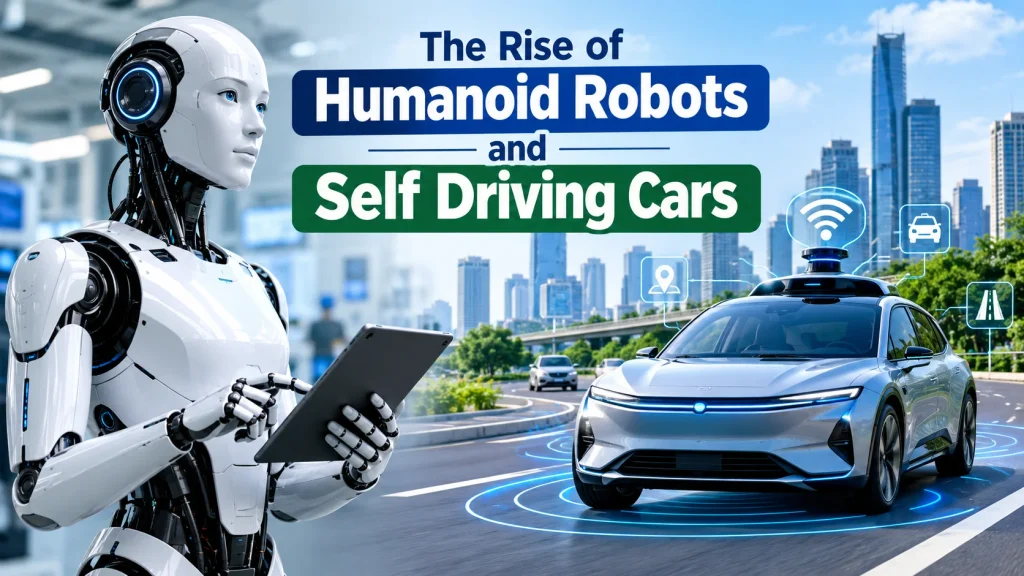
The Rise of Humanoid Robots and Self Driving Cars. Today the line between science fiction and reality is blurring more quickly than many of us anticipated . Humanoids robots and autonomous cars another term for self driving cars are crossing out of their laboratories and into our factories , warehouses and roads . If you keep tabs on technology, business or investment , this transition is worth noting.
Let’s unpack what’s really going on with humanoid robots and self driving cars and what the real promises and limitations are and how to approach them without getting caught up in the hypeWhether you’re a technology fan, a business owner, or just someone who wants to understand where the world’s heading, this guide will give you a down to earth sense of the future.
Humanoid Robots : From Stage Performances to Real Work
Humanoid robots for years were mostly parlor tricks . They could do backflips, dance and wow crowds at trade shows . But they couldn’t really do much of anything.
That’s changing quickly.
At this month’s World Robot Conference in Beijing, things went the other way : Robots showed off they could do real work with tasks like checking electrical cabinets, packaging products , folding clothing and cooking pasta. “What [we are now] interested in is ‘can think and work,'” said one robotics industry veteran.
Humanoid Robots and Self Driving Cars
Let’s look at concrete examples from companies shipping real products:
- Boston Dynamics’ Atlas : The next generation Atlas has a reach of about 2.3 meters, can lift up to 50 kilograms and operates in temperatures from minus 20 to 40 degrees Celsius. It has 56 degrees of freedom and human scale hands with tactile sensing. It can even swap its own battery when depleted.
- UBTECH’s Walker S2 : This robot features an autonomous, hot swappable battery system. It can swap depleted batteries for charged ones in under three minutes without human intervention. Humanoid Robots and Self Driving Cars.
- Pharmacy robots : In Shanghai, robots from Robbyant (an Ant Group company) already sort medication at several Sinopharm outlets. The key benefit : pharmacists can focus on customer consultations instead of running between shelves and registers.
- Home robots : Haier’s “Haiwa” robot can pick up a T shirt, load it into a washing machine, and press start. Another unit sorts groceries and places refrigerated items in the fridge. The company deliberately focuses on a few common chores to prove reliability before expanding.
The Business Case: Why Companies Are Betting on Humanoids
The driving force behind humanoid robots isn’t novelty it’s economics.
The global market for humanoid robotics, worth about $2-3 billion today according to Barclays Research, could surge to $200 billion by 2035 or so they hope, in an optimistic forecast . The logic is simple: Developing countries are getting old and the shortage of human labor is increasing everywhere in the developed world. Humanoids could handle the repetitious, physically demanding stuff. Humanoid Robots and Self Driving Cars.
Costs have also plummeted. Breakthroughs in AI reasoning, actuator technology, and battery systems have cut production costs 30 fold over the past decade. Tesla, for instance, aims to build Optimus units priced between $20,000 and $30,000, with manufactured costs potentially falling to $13,000–17,000 by 2030.
For developed economies where average factory wages exceed $45,000 annually, a humanoid’s $25,000–35,000 running cost is becoming competitive. Humanoid Robots and Self Driving Cars.
The Reality Check: Limitations and Barriers
Here’s where the hype needs tempering.
Gartner predicts that fewer than 20 companies will scale humanoid robots for manufacturing and supply chain to production stage by 2028. Most deployments will remain limited to tightly controlled environments rather than dynamic , high throughput operations.
The core problems are practical:
- Dexterity and intelligence : Current models lack the dexterity, intelligence, and adaptability for complex, unstructured environments like mixed SKU picking or exception handling in high velocity warehouses. Humanoid Robots and Self Driving Cars.
- Cost vs. performance : Humanoids currently cost multiple times more than task specific robots while delivering lower throughput and uptime. Humanoid Robots and Self Driving Cars.
- Energy constraints : Limited battery life restricts operational time for high mobility tasks.
A New York Times report captured the gap well. At a BMW factory in South Carolina, a humanoid robot recently performed tasks like pulling a trolley and placing auto parts. Its movements were described as “slow, stiff” more like “a worker with a bad hangover rather than a technological revolution”.
Self Driving Cars: The Quiet Revolution
While humanoid robots grab headlines, self driving cars are already operating in several cities just not in the way most people imagined. Humanoid Robots and Self Driving Cars.
Where Robotaxis Actually Stand
Tesla’s Cybercab rollout in Austin, Texas, offers a revealing look at the economics. Early fare comparisons showed Cybercab undercutting Uber by more than 50% on some routes : a 15-minute trip cost $9.65 versus $21.00 on Uber. Another comparison showed Tesla charging $19.35 for a route where Uber quoted $34.98.
But the story isn’t that simple. When demand outpaced supply, Cybercab fares surged. One 1.3-mile trip cost $15.24 on Cybercab while Uber charged $7.95. Wait times stretched beyond an hour. Humanoid Robots and Self Driving Cars.
The lesson: autonomous ride hailing can be cheaper when supply is sufficient but fleet scaling is the real challenge.
Meanwhile, Waymo has narrowed the price gap with traditional ride hailing. In the San Francisco Bay Area, Waymo’s average fare was $19.69 compared to Uber’s $17.47 and Lyft’s $15.47 during a late 2025 period. Waymo’s advantage is its larger fleet and shorter wait times (5.74 minutes versus Tesla’s 15.32 minutes).
Why Level 2+ Is Beating Level 3
Here’s something most people don’t realize: the industry is quietly shifting away from the most advanced autonomy. Humanoid Robots and Self Driving Cars.
Major automakers BMW, Mercedes Benz, and Stellantis all announced Level 3 “eyes-off” driving systems. Now they’re pulling back. BMW is discontinuing its Personal Pilot system. Mercedes is expected to drop Drive Pilot from the S Class and EQS. Stellantis shelved its Auto Drive program entirely.
The reason: liability and economics.
Level 3 systems shift liability to the manufacturer. They require expensive sensor stacks lidar, radar, cameras, high performance computing costing €6,000 , €7,000 per vehicle. Yet they only work in narrow conditions: good weather, approved highways, specific speeds. Humanoid Robots and Self Driving Cars.
Level 2+ systems, by contrast, keep the driver responsible. They offer hands free highway driving and system initiated lane changes with less hardware and lower cost. Regulators face fewer legal hurdles, so automakers can roll them out broadly.
The takeaway for consumers: expect more hands free driving on highways but true “sleep in your car” autonomy remains distant for personal vehicles.
Investment Angles: How to Think About This Space
If you’re interested in the business and investment side, here’s a framework.
The Physical AI Ecosystem
The opportunity isn’t just in robots and cars themselves. It’s in the enabling technologies:
- Actuators : The robotic “muscles” account for roughly 50% of humanoid production costs.
- Sensors and LiDAR : Companies like Hesai and RoboSense supply critical perception hardware. Humanoid Robots and Self Driving Cars.
- AI compute : Nvidia and Qualcomm are central to both humanoid and autonomous driving systems.
- Battery technology : Advances from the EV industry directly benefit humanoids.
ETFs for Exposure
Several ETFs offer diversified exposure:
- ARK Autonomous Technology & Robotics ETF (ARKQ) : Focuses on autonomous tech and robotics, with top holdings including Tesla and Teradyne.
- Global X Autonomous & Electric Vehicles ETF (DRIV) : Includes semiconductor and software companies enabling autonomous driving.
- Roundhill Robotaxi Autonomous Vehicles & Technology ETF (CABZ) : Targets the robotaxi ecosystem specifically. Humanoid Robots and Self Driving Cars.
Important caveat : These are thematic ETFs with higher volatility than broad market funds. They’re suitable for investors with higher risk tolerance and a long time horizon.
Practical Tips for Navigating This Transition
If You’re a Business Owner
- Start with pilot programs not full deployments . Gartner advises validating feasibility before committing to scale. Humanoid Robots and Self Driving Cars.
- Focus on specific bottlenecks not generalized headcount reduction . Outcome driven automation is less risky.
- Consider polyfunctional robots first . For many warehouse and logistics tasks , wheeled robots with telescopic arms outperform humanoids at lower cost.
If You’re a Job Seeker
The robots aren’t coming for every job at least not yet . The tasks most at risk are repetitive, physically demanding and performed in controlled environments . The tasks safest are those requiring complex judgment, creativity and human interaction. Humanoid Robots and Self Driving Cars.
If You’re an Investor
- Don’t chase headlines. The gap between announcement and profitable deployment is long.
- Watch fleet scaling metrics for robotaxis (wait times, coverage area) and production costs for humanoids.
- Consider the picks and shovels approach: actuators, sensors and compute may offer more stable returns than robot makers themselves.
Common Mistakes to Avoid
- Believing the timeline hype. Robots that “will be in every home by 2025” didn’t materialize. Real deployment is slower and messier.
- Ignoring the liability question. For self driving cars, who pays when something goes wrong? This isn’t a minor detail it’s shaping the entire industry’s direction.
- Confusing demonstrations with products. A robot folding laundry in a controlled demo is very different from one doing it reliably in your home.
- Overlooking the energy constraint. Battery life limits both humanoids and EVs. This is a fundamental physics problem, not just an engineering one.
- Assuming one size fits all autonomy. The future is likely a mix : Level 2+ for personal cars, Level 4 in geofenced robotaxi zones and humanoids in structured factory settings.
Frequently Asked Questions (FAQ)
What is a humanoid robot?
A humanoid robot is designed to mimic the human body in shape, function, and locomotion. It typically has a head with sensors, arms with grippers and legs for walking. This form factor allows it to operate in environments built for humans without facility modifications.
Are humanoid robots actually being used in factories today?
Yes, but at limited scale. BMW has tested humanoids at its South Carolina plant. Hyundai plans to deploy Boston Dynamics’ Atlas in component assembly by 2030. However, Gartner predicts fewer than 20 companies will reach production scale deployment by 2028.
What’s the difference between Level 2 and Level 3 self driving?
At Level 2, the driver must monitor the environment and remain ready to take control. At Level 3, the system monitors the environment and the driver can do other things but only within specific conditions. The manufacturer assumes liability at Level 3.
Why are automakers pulling back from Level 3?
High costs, limited operational conditions, and weak consumer demand. Level 3 systems require expensive sensors and only work in narrow scenarios. Meanwhile, Level 2+ systems offer many of the same features with less liability and broader deploy ability.
How much do humanoid robots cost?
Costs vary widely. Tesla aims for Optimus units priced at $20,000–$30,000. Manufactured costs could fall to $13,000–$17,000 by 2030. Operating costs today run $0.75–$1.25 per hour.
Are robotaxis cheaper than Uber?
Sometimes. Tesla’s Cybercab has undercut Uber by more than 50% on some Austin routes. But when demand exceeds supply, surge pricing can make robotaxis more expensive. Waymo’s fares are now roughly comparable to Uber in some markets.




2 Comments