AI PC AI Smartphone and Smart Glasses Explained 2026
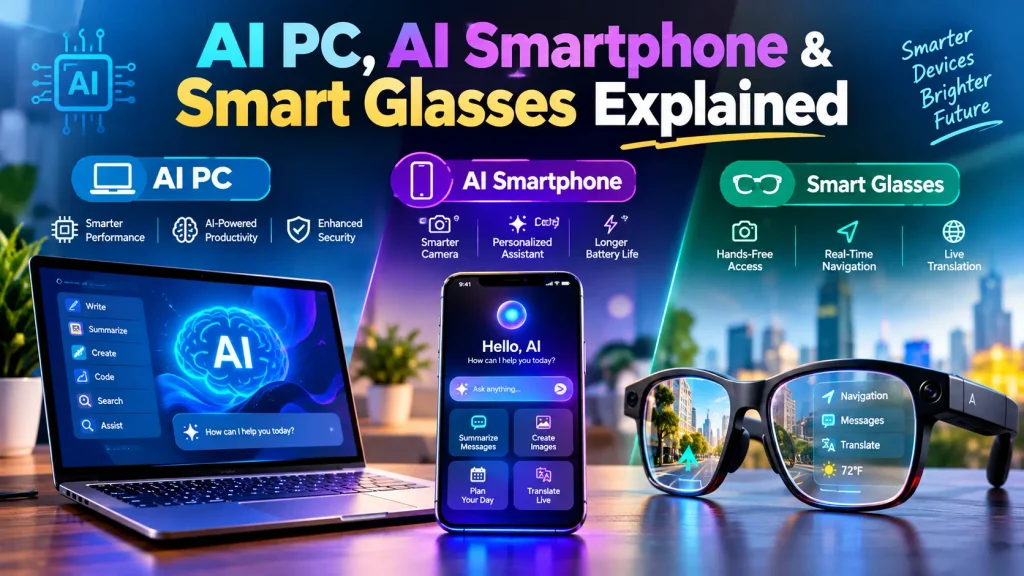
AI PC AI Smartphone and Smart Glasses Explained 2026. Smart tech is moving at an unprecedented pace We saw this coming long ago : artificial intelligence in the cloud. You ask a question, a moment of lag, then the solution is delivered to your device via the cloud. That was a slow evolution.
In 2026, the most exciting technology is happening at your desk in your hand and on your face. The AI PC AI phone and smart glasses are no longer visionary product concepts ; they’re available today and are transforming the way we work, create and communicate.
These Are the Three Key Types of Devices How they differ from regular gadgets, what these devices can do for you today, where they’re lacking and how to know if they belong in your life. Whether you’re a professional searching for a productivity boost a creator seeking new tools, or just someone wondering what gadgets the future might hold, you’ll learn about each of these devices, including the basics you’ll need to be successful with them.
What Is an AI PC?
What is an AI PC? An AI PC is a PC that contains a dedicated piece of hardware, an NPU, which exists solely to perform AI workloads locally instead of uploading to the cloud. It might seem like a minor technical distinction, but an AI NPU completely shifts what your PC can do.
The premise is pretty straightforward. Today’s PC have a CPU for general purpose work and a GPU for graphics work . If you use an AI feature for creating images or doing live transcription, that work is usually sent off to a cloud-based server, performed and then sent back adding latency, requiring an internet connection and not particularly great from a privacy perspective because your data leaves the PC . An AI PC is meant to do that work locally on your PC using the AINPU and keep everything fast, private and local.
What AI PCs Can Do Right Now
The practical benefits are becoming clearer as software catches up with the hardware. Here are the most useful capabilities available today:
- YOUR LOCAL AI BOTS Write emails, Agenda , Summarise documents. All on your device. No clouds, No data leaks!
- Real time transcribing and translating in meetings with instant viewing of results.
- Earth friendly image editing. Full Image Gen2 is baked right into your device. Adobe is bringing the Firefly engine to NPU in the Creative Cloud.
- Coding help and debugging for developers: Integrate AI models into your own IDE to get coding suggestions bug explanations and code snippets.
- Video generation and editing : using AI models that previously required server-class hardware.
HP describes this shift as moving from a “personal computer” to a “personal intelligence device,” where AI agents work alongside you rather than waiting for your commands. Nearly 72% of organizations are already deploying or piloting AI agents, and this trend is pushing demand for more capable local hardware.
The Current AI PC Landscape
Several chip architectures are competing for your attention. Intel’s Lunar Lake and Panther Lake processors, AMD’s Ryzen AI series, and Qualcomm’s Snapdragon X Elite and X2 chips all deliver different levels of NPU performance. Qualcomm’s Snapdragon X2 Elite currently leads in raw NPU throughput, which matters for running larger AI models locally.
Major PC makers including HP, Dell, Lenovo, Asus, and Microsoft have all released AI PC models. Microsoft’s Surface Pro 12-inch and Surface Laptop 13-inch, powered by Snapdragon X2 Plus, deliver up to 95% faster AI inference compared to previous generations. HP reported that AI PCs made up 44% of its PC shipments in a recent quarter, up from 35% previously.
Real Limitations to Consider
There is no shortage of bumps on the road to AI PC dom. Nvidia’s launch of its RTX Spark chip signals a trend but Nvidia’s major customer base for those devices will be developers and content creators that require access to very large models on premises. Analysts note that models’ high cost and ongoing shortage of memory chips will restrict those devices to niche adoption for now.
There is also a gap between marketing and reality. Many “AI PCs” sold over the past two years have centered on modest features like basic transcription or simple image editing that did not give most people a compelling reason to upgrade . The hardware is ahead of the software in many cases, though that gap is closing .
What Makes an AI Smartphone Different?
Buy A Flagship Last Year? You Might Already Have An AI Phone In Your Hand Counterpoint Research projects 45% of smartphone sales globally will be Gen AI phones in 2026, up from 36% in 2025. It will likely also exceed 50% by 2027. If you bought a flagship in the last year, you probably already have a Gen AI phone in your hands.
So, what does “AI smartphone” even mean outside of marketing puffery? Well, it’s changing rapidly. The first generation of AI phones had features such as generative photo editing, real-time translation and more advanced voice assistants ; this next generation is aiming a little higher: agentic AI that actually does things for you.
The Agentic Shift
For example the Galaxy S26 Ultra is built with One UI software that uses AI tech in everything, from its data driven Now Nudge and Now Brief that work proactively by creating summaries and contextual suggestions plus AI-powered reminders all on the device to ensure speed and protection for your privacy . It has Gemini, Gemini Live, Bixby and Perplexity all integrated.
Xiaomi’s 18 Pro series employs a similar technique with its Super Xiao Ai 2.0 assistant, which is implemented with a locally trained on device model . It can transcribe voice and keep notes but can also arrange a trip communicate with smart home devices, and manage several activities at once. Xiaomi says that the 18 Pro will be the first of a full scale AI overhaul of the phone experience.
The most ambitious idea is Chinese makers marketing “AI agent phones” that use voice to order food, shop and even write messages. But the biggest problem with this is the platforms. When Byte Dance released a beta version of its AI phone that could order food and browse prices, Alibaba Tencent and JD.com quickly limited the assistant’s access with some functions having to be turned off. The biggest challenge to any level of true autonomy is access to the platform.
What AI Phones Do Well Today
For most users, the most valuable AI phone features are practical and already working :
- Smart photo & video editing that can cut out objects, optimize images of poor quality and auto enhance.
- Real time translation in conversations, breaking down language barriers in the moment.
- Concise Summaries Easy to read notifications, emails & messages so you can easily scan and get the information you want.
- Bespoke help, knowing what you’re doing and where you need a hand without asking.
- Reliable voice first interactions for everyday tasks such as messaging, reminders, and search.
The Upgrade Problem
Here is the uncomfortable truth for phone makers : AI capability has not yet given most consumers a compelling reason to upgrade . A clear gap remains between devices that are AI capable and those on which users regularly engage with AI features . Many people buy an AI phone use the camera, browse social media and never touch the AI features.
The memory chip supply situation is making things worse. Higher component costs are pushing phone prices up while some manufacturers reduce base memory and storage in lower tier models. Counterpoint Research expects the budget segment to shrink the premium segment to grow and the refurbished market to expand as buyers keep devices longer.
Smart Glasses: The Next Computing Frontier?
Smart glasses have had a long and bumpy journey from Google Glass’s infamous failure to today’s surprisingly wearable products. The category finally started making sense in 2025, and 2026 is shaping up to be a make-or-break year.
Meta dominates the current market with 68.7% share in the second quarter of 2026, driven by its Ray Ban collaborations and aggressive expansion into prescription eyewear . Audio glasses, the display-less category that includes most Ray Ban Meta models, represented the largest portion of shipments at 70.3% share. Display glasses, which project information into your field of view, remain a smaller but growing segment.
The market is splitting into two distinct product philosophies . The first is the ambient AI companion : glasses that look like normal eyewear, sound useful and let you ask questions , take calls, listen to music , translate signs or capture moments without introducing a visible display . Meta’s Ray Bans sit squarely in this camp . The second is the standalone spatial computer, devices that project digital graphics into the real world and ask the wearer to do more than listen. Snap’s new Specs, priced at $2,195 represent this more ambitious and currently more niche approach.
What Smart Glasses Can Do Today
The most polished smart glasses handle a focused set of tasks well:
- Hands free photos and video with a simple voice command or tap, perfect for capturing moments when pulling out your phone would be awkward.
- Live translation appearing on the lenses, with support for dozens of languages. Even Realities glasses offer over 35 languages and can project speech scripts for presentations.
- Navigation prompts that keep your eyes on the road or trail while providing turn by turn directions.
- Meeting summaries and note taking through integrated AI assistants like Google Gemini, available on Samsung’s new smart glasses.
- Accessibility features for visually impaired users, including object identification and menu reading.
Battery life is improving but remains a constraint . Meta’s Ray Ban Display offers 9 hours of use, while Samsung’s first generation glasses reach 9 hours with Google Gemini pre installed . Even Realities claims a two day battery life for its 36 gram glasses, making them light enough for all day wear.
The Honest Challenges
Smart glasses are getting good fast, but they are not yet for everyone. The technology remains expensive, and camera quality lags far behind even small action cameras. You cannot see the framing when capturing photos, which leads to awkward angles and missed moments. Durability is another concern. Drop an action camera and you shrug. Drop your smart glasses and you may be shopping for new ones.
Privacy is the elephant in the room. Smart glasses are the most covert recording devices most people will ever wear. Tiny indicators and small lenses mean not everyone knows when they are being captured . Public acceptance is improving but trust still lingers behind curiosity . IDC notes that recent privacy backlash over always on recording shows not all attention is flattering.
How These Three Devices Work Together
What’s most fascinating is not any one of them but rather how they are beginning to become an ecosystem. Your AI phone is for short bursts, consumption, communication. Your AI PC is for higher impact work, the heavy lifting of work, running the local model. Your smart glasses are what’s ambient, what keeps you plugged in without your having to pick up a screen.
It’s a maze. For now, every kind of device is siloed within its own software environment, with own set of privacy rules and restrictions. But the trend is obvious: Meta is integrating its smart glasses into the Facebook and Instagram platform, extending to holographic WhatsApp video calls and phone screen mirroring. Samsung links its Galaxy devices and its new Galaxy glasses with the same voice assistant and other AI services.
For now, the way forward is to buy whichever device most easily addresses your current need. If you can’t stop editing photos or videos, then a potent AI PC will be a game changer in your workflow. If the most important thing is communicating and instant AI support then a capable AI phone will give you the best bang for your buck. If you want hands free capture and ambient info, smart glasses are finally worth a look.
Also Read : How to Make Money with AI 2026
Common Mistakes to Avoid
Shopping for something you won’t use . Most people buy AI PCs or AI phones just for the features they do not end up using. Write down the things you will actually do . If you’re not into regularly editing pictures , creating content or using AI assistants, then it might not be worth the investment.
Anticipating perfection from the first products . Smart glasses, especially are still a long way from ideal . The camera quality , battery and AI will get better with the next generation . So, if you’re an early adopter don’t have unrealistic expectations.
Overlooking privacy tradeoffs. While on device AI processing is more private than cloud processing , always on cameras and microphones may bring new privacy concerns. Know what data your smart glasses and similar devices are collecting how it’s being used, and what you are giving up to make your device work.
Ignoring the total cost of ownership. These top end AI devices and AI phones tend to be more expensive and subscription costs may be required for some AI features (e.g. to use the Ink Canvas AI features in Microsoft Word you will need an eligible Microsoft 365 subscription). Consider these costs when deciding.
Frequently Asked Questions (FAQ)
What can AI smartphones actually do that regular phones cannot?
AI smartphones run generative AI models locally for tasks like photo editing live translation and intelligent summaries . The latest models also support agentic AI that can perform multi step tasks across apps , though platform restrictions still limit full autonomy.
Are smart glasses worth buying in 2026?
If you want hands-free photo and video capture, live translation, or ambient navigation, the best current models deliver real value. If you expect a full augmented reality computer on your face , you will be disappointed at current price points.
How long does smart glasses battery last?
Battery life varies significantly . Meta’s Ray Ban Display offers around 9 hours, Samsung’s first generation glasses reach 9 hours and Even Realities claims up to two days for its lighter audio focused model.
Will AI phones replace apps?
Not anytime soon. AI assistants still struggle with accessing third-party apps and services due to platform restrictions and technical limitations. The goal of a truly autonomous AI assistant remains unrealized.
Do AI PCs cost more than regular PCs?
Generally yes. The premium comes from the dedicated NPU hardware and higher memory requirements. However, prices are gradually coming down as the technology matures and competition increases.
Can smart glasses replace my regular glasses?
Some models are designed as prescription eyewear replacements. Meta has expanded into prescription lines and Even Realities glasses weigh just 36 grams, light enough for daily wear. However, you may still want separate glasses for activities where you do not want technology on your face.
What is the biggest limitation of AI smartphones?
The gap between what phones can theoretically do and what people actually use. Gen AI capability has become standard in premium phones, but most users have not found compelling daily reasons to engage with AI features.
Should I wait for the next generation of these devices?
If you need the capability now buy now. If you are curious but not urgent, waiting six to twelve months typically brings better performance, improved software and more competitive pricing across all three categories.
The Bottom Line
The AI PC, AI smartphone, and smart glasses represent three different approaches to the same goal: putting artificial intelligence directly into the devices you use every day. Each category has genuine strengths and real limitations. AI PCs deliver powerful local processing for creative and professional work. AI phones offer the most accessible entry point to generative AI features. Smart glasses provide a new kind of ambient interface that keeps you present while staying connected.
The smartest approach is to start with the device that solves a problem you actually have. Do not buy technology because it sounds impressive. Buy it because it makes something you do regularly faster, easier, or better.
What has been your experience with AI powered devices? Have you tried an AI PC, upgraded to an AI phone or experimented with smart glasses? Share your thoughts in the comments below. If you found this guide helpful, share it with someone who is trying to make sense of the AI device landscape.



2 Comments