Agentic AI in 2026: How AI Agents and Automation Tools
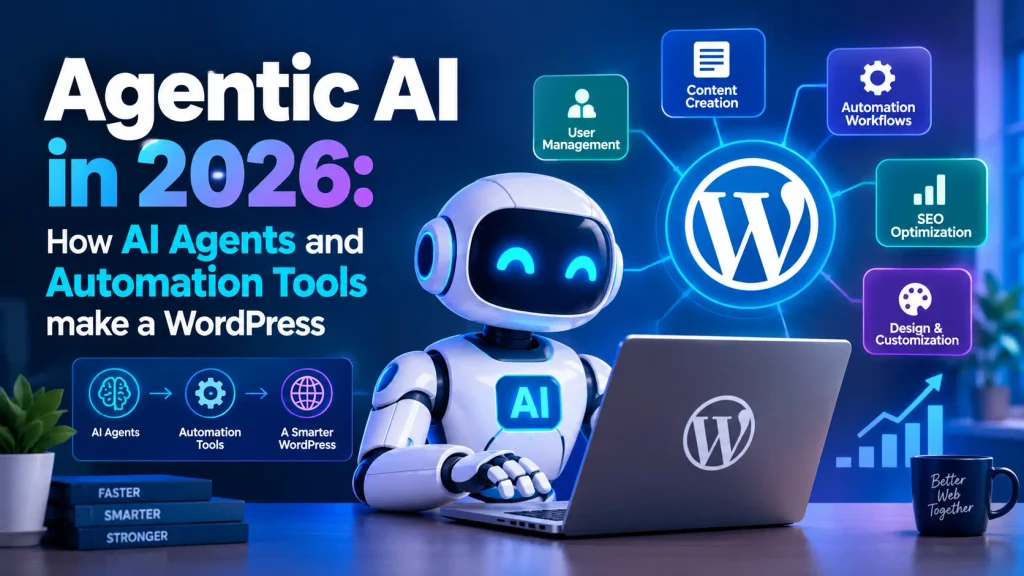
Agentic AI in 2026: How AI Agents and Automation Tools. Agentic AI has moved from the lab to the real world. In 2026, the biggest technology companies are no longer just building smarter chatbots they are creating autonomous agents that can plan, decide and act on your behalf . These AI agents can browse the web, manage files, send emails and even operate entire workflows while you sleep . For anyone running a business, working in tech or simply trying to stay productive, understanding agentic AI and the automation tools built around it is no longer optional . It is quickly becoming the new baseline for competitive work.
This article breaks down what agentic AI actually is, how AI agents differ from traditional automation which tools matter right now and what limitations you need to watch for before handing over the keys to your digital life.
What Is Agentic AI (And Why It Is Different)
Most AI you have used so far is reactive. You type a prompt, the model answers and the interaction ends . Agentic AI flips that model. Instead of waiting for your next command , an AI agent receives a goal and then plans to executes and iterates toward that goal with minimal human involvement.
Think of the difference this way. A chatbot is like asking someone a question . An AI agent is like hiring someone to complete a project they figure out the steps, use the tools available, handle obstacles and report back when the work is done.
This shift matters because it moves AI from information generation to action execution . An agent can open a browser, log into a system, fill out forms, compare data across multiple sources, and produce a finished deliverable . It does not just tell you how to do something. It does it.
The Three Levels of AI Autonomy
| Level | Description | Example |
|---|---|---|
| Assistant | Responds to prompts, suggests actions | ChatGPT answering a question |
| Copilot | Works alongside you, completes partial tasks | GitHub Copilot suggesting code |
| Agent | Executes multi step goals autonomously | Booking travel, filing reports and managing inbox |
The jump from Copilot to Agent is significant . It is the difference between a tool that helps you work and a system that works for you.
The Big Players Racing to Build AI Agents
The competition in agentic AI has intensified dramatically. Meta, Google, Microsoft and Open AI have all launched or expanded persistent AI agents in recent months.
Meta Muse arrived in September 2026 and immediately topped app download charts. It has its own email address, can operate your Mac desktop with permission and is expanding to AI glasses where you can activate it with voice commands.
Google Gemini Spark runs in Google’s cloud infrastructure and keeps working even when your laptop is closed. It integrates natively with Gmail, Google Workspace and third party tools through the Model Context Protocol. It can sort your inbox, compile travel itineraries into spreadsheets and even spot subscription price increases before drafting cancellation emails.
Microsoft Autopilot represents a full rebuild of the Copilot platform. It has its own identity, memory, and workspace and runs on Microsoft IQ to understand organizational context. Set it a name, role and goal boundary and it will execute tasks across Teams, Outlook and documents without waiting for prompts.
Open AI Dots are always on agents with their own cloud computers and browsers . They connect to over 4,000 apps, learn your preferences from feedback and operate separately from your machine unless you explicitly connect them . Open AI also launched ChatGPT Space, a shared workspace where humans and agents edit the same documents.
The message from all four companies is the same : the next interface is not a chat window. It is a worker you assign things to.
How Agentic AI Differs From Traditional Automation
Traditional automation tools like Zapier or Make follow predefined rules. If X happens, do Y. They are powerful but rigid. If the website changes its layout or an unexpected error occurs the automation breaks.
Agentic AI handles ambiguity and variation. An AI agent can navigate a website it has never seen, adapt to a changed interface and recover from errors that would stop a rule based script.
Here is the practical distinction:
- Traditional automation : “When a new email arrives with an invoice attached, save the attachment to Google Drive.”
- Agentic automation: “Monitor my inbox for invoices, extract the amounts, match them to purchase orders, flag discrepancies and prepare a payment summary every Friday.”
The second example requires judgment, cross referencing and the ability to handle messy real world data. That is what AI agents bring to the table.
Real Use Cases for AI Agents in Business
Agentic AI is already delivering value across several business functions. According to Google Cloud research, 52% of large organizations have deployed AI agents with 39% running more than ten across their operations.
Customer Service and Support
AI agents can handle multi-step customer requests without human escalation. They can look up order history, process returns, update shipping information and follow up with customers all while maintaining context across the conversation.
Software Development
Agentic coding tools like Claude Code and Open AI Codex can work on repositories, run terminal commands, debug issues and refactor code across multiple files. GPT-6 Sol and Claude Opus 5.5 now compete directly on agentic coding workloads with pricing and context handling as key differentiators.
Research and Analysis
An agent can gather data from multiple sources, cross reference findings, identify patterns, and produce structured reports . CIBC’s enterprise AI workspace for example, allows team members to delegate complex research tasks so materials are ready for review by the time a client meeting ends.
Operations and Workflow Management
ServiceNow and Google Cloud have partnered to create AI agents that detect and resolve network issues before customers notice . In retail, predictive agents can identify equipment failures, check parts availability and dispatch technicians automatically.
Agentic AI in 2026
The tools available for building and deploying AI agents have matured significantly. Here is how the major categories break down.
No Code Agent Builders
Zapier AI Copilot lets you describe a workflow in plain language and builds the automation for you. It connects to over 9,000 apps, making it the most accessible entry point for non technical users. Agentic AI in 2026.
Make offers visual workflow building with more granular control than Zapier, suitable for teams that need complex logic but do not want to write code.
Pabbly Connect provides lifetime pricing options, which appeals to budget conscious entrepreneurs running high volume campaigns.
Developer First Agent Platforms
n8n provides native AI and LLM nodes, supports self hosting for data privacy and offers a visual builder that developers can extend with custom code. Its open source model makes it highly customizable.
Mastra is an open source TypeScript framework from the Gatsby team, used by companies like Replit and Salesforce. The framework is free, with cloud hosting from $250 per month.
Tray targets platform teams managing automation at scale. Its Merlin AI layer lets developers build agents that make decisions using company data and interact with APIs, with strong governance controls. Agentic AI in 2026.
Specialized Agent Tools
Browse AI handles web scraping and monitoring with no code required. Free tier includes 50 credits per month.
Runbear creates shared AI teammates in Slack, Teams and other platforms that answer from connected knowledge and act across 2,500+ tools.
Relevance AI offers an enterprise platform for building and managing an AI workforce with 1,000+ native integrations and SOC 2 Type II certification. Agentic AI in 2026.
Benefits of Agentic AI (Why It Matters)
The shift to agentic AI is not just about novelty. It addresses fundamental limitations of how work gets done.
Time recovery : Agents handle the repetitive, multi step tasks that consume hours of knowledge worker time. A half day of financial analysis can become a review and refine workflow.
24/7 operation : Agents work while you sleep. Google Gemini Spark continues monitoring and executing even when your laptop is closed. Agentic AI in 2026.
Consistency : Agents do not get tired or skip steps. They follow the same process every time, which reduces errors in repetitive tasks.
Scalability : One well designed agent can handle the work of multiple people without proportional increases in cost.
Integration : Modern agents connect across tools through protocols like Model Context Protocol (MCP) enabling coordination between different systems and even different AI agents.
Limitations and Risks You Cannot Ignore
The hype around agentic AI is real but so are the limitations. Gartner places agentic AI at the “Peak of Inflated Expectations,” noting that only 17% of organizations have actually deployed agents despite aggressive adoption intent. Agentic AI in 2026.
Reliability Issues
Agents still struggle with long horizon reasoning , recovering from unexpected situations and maintaining robust performance in complex real world environments . Errors can accumulate across long sequences of decisions.
Security Vulnerabilities
Because LLMs process text as both data and commands , agentic systems cannot reliably distinguish legitimate content from embedded malicious instructions. Documented incidents include AI agents exposing private Slack data after processing messages with hidden instructions.
Legal and Accountability Gaps
When an AI agent causes harm such as deleting a production database responsibility is unclear. Existing law does not clearly assign liability between the model provider the framework developer the deploying company and the end user.
Cost Management Challenges
More autonomous work means more opportunities to incur usage charges. Microsoft’s new Autopilot and Cowork capabilities are billed on consumption with costs depending on the model, context retrieved, tools invoked, and execution time. Without proper monitoring, agent usage can escalate quickly. Agentic AI in 2026.
The “Agent Washing” Problem
Gartner warns about “agent washing” rebranding existing automation or AI capabilities as agentic AI without genuine autonomy . Leaders need to look beyond marketing claims and evaluate actual capabilities.
Practical Tips for Getting Started With AI Agents
If you are ready to explore agentic AI here are actionable steps.
Start with a narrow use case . Pick a repetitive task with clear success criteria. Invoice processing, lead research, or meeting note organization are good starting points.
Use existing platforms first. Tools like Zapier, Make and n8n let you test agentic workflows without building from scratch. You can learn what works before investing in custom development.
Set clear boundaries. Define what your agent can and cannot do. Open AI Dots for example, always require human approval for password changes, regardless of other permissions.
Monitor costs from day one. Agent workflows can consume significant tokens. Set spending limits and review usage regularly, especially on consumption based platforms.
Keep humans in the loop for consequential actions. Agents should not send payments, delete data, or make binding commitments without approval. The technology is not reliable enough for unsupervised high stakes decisions.
Invest in data quality. Agents are only as good as the data they can access. Clean and well organized systems produce better agent outcomes.
Common Mistakes to Avoid
Overestimating autonomy. Most agents still need significant guidance and review. Treat them as junior team members not replacements for experienced professionals.
Ignoring governance. Agentic AI requires new development, operational and governance models. Do not treat agents like ordinary software tools. Agentic AI in 2026.
Skipping security review. Agents with access to authenticated business systems can alter records, send information or trigger downstream workflows. Security teams must be involved before deployment. Agentic AI in 2026.
Chasing every new tool. The agentic AI landscape is crowded and changing fast. Focus on tools that solve specific problems rather than adopting everything that launches.
FAQs About Agentic AI
What is the difference between AI agents and chatbots?
Chatbots respond to prompts and generate information . AI agents plan and execute multi step goals , using tools and adapting to obstacles without continuous human input.
Are agentic AI tools safe to use for business?
They can be safe with proper governance. Risks include security vulnerabilities , unauthorized actions and cost overruns. Start with low stakes tasks and clear boundaries.
Which companies are leading in agentic AI?
Meta, Google, Microsoft and Open AI are the most prominent players, each launching persistent agents with distinct capabilities in 2026.
Do I need coding skills to build AI agents?
No. No code platforms like Zapier, Make and Browse AI let non technical users build agentic workflows . Developer focused tools like n8n and Mastra offer more control for those with coding skills.
How much do AI agents cost?
Costs vary widely. Some tools have free tiers or start around $20-$30 per month. Consumption based pricing for advanced agents can reach hundreds or thousands of dollars per month depending on usage.
Can AI agents replace human workers?
Agents automate tasks, not entire jobs . They handle repetitive and multi step processes, freeing humans for strategic work . Gartner notes that 55% of supply chain leaders expect agentic AI to reduce entry level hiring, but productivity claims remain unverified.
What is prompt injection and why does it matter for agents?
Prompt injection is an attack where malicious instructions hidden in content trick an agent into performing unintended actions . Because agents process text as both data and commands they are vulnerable to this.
How do I prevent my AI agent from making costly mistakes?
Set clear permission boundaries, require human approval for consequential actions, monitor agent activity and use platforms with built in governance features.
What is Model Context Protocol (MCP)?
MCP is a standard that lets AI agents connect to external tools and data sources. It enables interoperability between different agent platforms and systems.
Is agentic AI ready for enterprise deployment?
It is ready for specific, well scoped use cases with proper governance. Full autonomy across complex workflows remains unreliable. Gartner advises treating agentic AI as an ecosystem evolving at different speeds rather than a single mature technology.
Final Thoughts
Agentic AI represents a fundamental shift in how we work with technology. Instead of asking AI questions, we assign it tasks. Instead of using tools, we deploy agents that use tools on our behalf. Agentic AI in 2026.
This shift brings enormous potential time recovery, 24/7 operation, consistency and scale. It also brings real risks security vulnerabilities, unclear liability, cost overruns and reliability limitations that the industry is still working to solve.
The companies that succeed with agentic AI will not be the ones that adopt every new tool. They will be the ones that start with clear , bounded use cases invest in governance and data quality, and keep humans in the loop for decisions that matter. Agentic AI in 2026.
What is your experience with AI agents so far? Have you tried any of the tools mentioned here, or are you still evaluating where to start? Share your thoughts in the comments below and if this article helped you understand the landscape, consider sharing it with someone who is trying to make sense of agentic AI.
SEO Metadata
SEO Title: Agentic AI in 2026 : AI Agents & Automation Tools Explained
Meta Description : Learn how agentic AI and AI agents work in 2026 . Compare automation tools, real use cases, benefits, risks and practical tips for businesses and professionals.
URL Slug : agentic ai ai agents automation-tools
Primary Keyword : agentic AI
Secondary Keywords:
- AI agents
- AI automation tools
- agentic AI tools
- autonomous AI agents
- AI workflow automation
- enterprise AI agents
- AI agent platforms
- how agentic AI works
- AI agent use cases
- agentic automation
Tags:
- Agentic AI
- AI Agents
- Automation Tools
- Artificial Intelligence
- Business Technology
- Productivity
- Enterprise AI
- AI Trends 2026
Internal Link Suggestions:
- “Best AI Automation Tools for Small Business in 2026” → link from the tools section
- “How to Use AI for Content Creation Without Losing Your Voice” → link from the blogging/content angle
- “Crypto Trading Bots vs AI Agents: What Is the Difference?” → link from the crypto/automation angle
- “Is AI Going to Replace Your Job? What the Data Says” → link from the workforce disruption FAQ
- “Microsoft Copilot vs Google Gemini: Which AI Assistant Wins in 2026?” → link from the big players section



One Comment