Crypto & Technology Trends 2026: Tokenization, AI, and What’s Next?
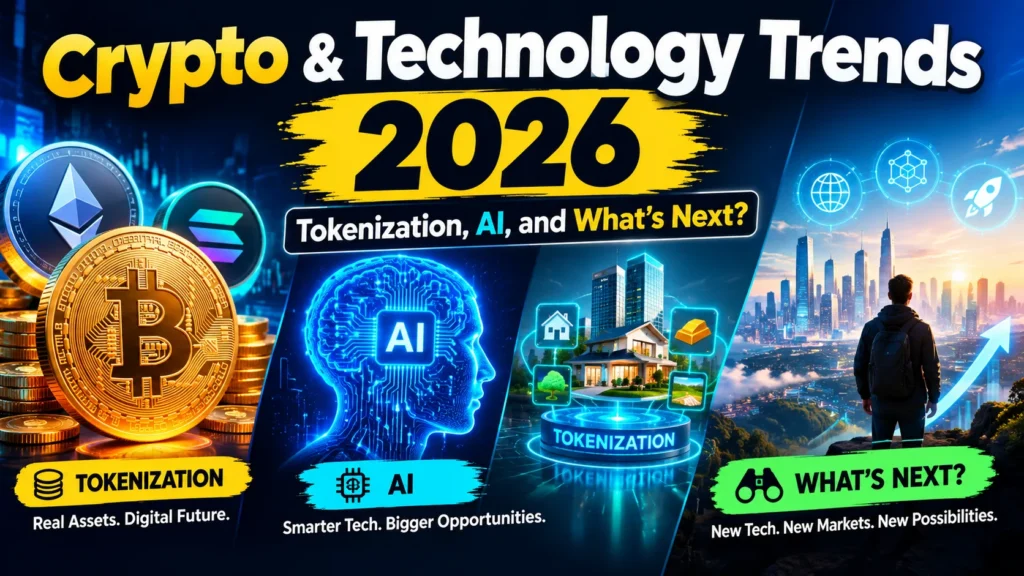
Crypto & Technology Trends 2026. You know what’s strange about 2026? It’s not loud. Every other year in crypto was loud. Price going crazy, everyone yelling on X. This year feels different. It’s quiet. But it’s a busy kind of quiet. Like when people are actually working.
For the first time, it feels like blockchain is not just an idea. Banks are actually using it, not just testing it for a press release. Governments finally stopped saying “we’ll look into it” and started writing real rules. And the weirdest thing AI just gave crypto a proper job. Not as money for people, but money for AI bots.
If you waited for crypto to grow up, this is it. It’s finally starting to grow up.
But that also makes it harder. Because now there is too much news. Every headline says “this is the future”. Not every headline is the future. So I wanted to write this guide about crypto and technology trends 2026 in simple words what’s actually happening with tokenization, stable coins, AI, regulation, staking and what it means if you are building something, investing, or just trying to not get lost
Crypto & Technology Trends 2026: The Regulatory Fog Is Finally Lifting
For years, the biggest problem was not technology. It was fear. Imagine you are a founder. You raise money, build a product for one year, and then one day a regulator in the US says your product was illegal from day one. Who would want to take that risk? Nobody. So most good companies just stayed away.
That is finally changing now.
Clearer Frameworks in Major Markets
- 2025 was the year things actually moved. Singapore and UAE just did it. They didn’t do long speeches, they made full rulebooks and said “if you follow this, you are safe to build here.”
- Then stablecoins pushed everyone. Hong Kong made rules. Europe made rules. US made rules. In the US, the GENIUS Act was a big deal. When US moved, other countries thought “we have to move too now.”
- Now the next one is Clarity Act in the US. This one is trying to answer the most basic question what is a security, what is a commodity, and how should crypto exchanges be regulated. It’s boring stuff, but we needed this 5 years ago.
- What this means for you: When rules are clear, real money comes. Investors don’t like confusion. Founders don’t like confusion. Clear rules means people can actually plan long term.
The CBDC Question Remains Open
- CBDCs, government digital currencies, still no clear answer.
- Australia’s Reserve Bank checked it properly and in 2026 said look, we don’t really need a retail CBDC.
- Our current system already works well for normal people. UK is still designing, they will show a blueprint later this year.
- Rwanda is studying it but they are very careful, because building it is very hard.
- I think that’s actually good. Not every country needs a CBDC. It’s not like one size fits all. Some countries need it, some don’t.
Tokenization: From Buzzword to Real Market
I have been hearing the word tokenization since maybe 2017? “We will put houses on blockchain!” For years it was just talk on stage.
In 2026, it’s not talk anymore. You can see it in numbers.
The Numbers Tell the Story
By March 2026, tokenized assets market reached about $50.37 billion. If you compare with whole world finance, it’s still very small. But look at growth speed 65% in 2023, 93% in 2024, and 169% in 2025. That’s not slow growth, that’s crazy fast.
Where is this money? Mostly in boring things, which is good:
| Asset Class | Market Size (March 2026) | Share |
|---|---|---|
| Credit assets (mortgages, loans, bonds) | $25.65B | 51% |
| Money market funds & government bonds | $14.26B | 28% |
| Commodities (mostly gold) | $7.30B | 14% |
| Alternative investments (real estate, private credit) | $2.19B | 4% |
Mostly bonds and money market funds and credit. Not cartoons. Boring, but real.
Why Institutions Are Paying Attention?
When BlackRock starts talking about tokenization as a main theme for 2026, you listen. Their Bitcoin ETF IBIT already has over $70 billion. And they are openly saying Ethereum could benefit a lot from tokenization because most of this stuff happens on Ethereum.
Why they like it? Because it fixes stupid problems:
- Fractional ownership: You don’t need 500k to buy a house. You can buy $100 part of it.
- 24/7 trading: Why should market close on Saturday? Code never sleeps.
- Programmable compliance: You can write rule inside token itself — like “only transfer if KYC done.”
- Faster settlement: Instead of waiting 2 days, it settles in seconds.
But be careful: Tokenizing doesn’t remove risk. It just changes the risk. Smart contract can have bug. Who is actually keeping the real house or gold? If that company goes bankrupt, does your token still mean anything in court? We are still figuring that out.
Also Check: Hot Wallet vs Cold Wallet: Which Is Safer in 2026?
Stablecoins Become the Internet’s Payment Layer
If tokenization is big bank story, stablecoins is normal people story. This is the one people actually use daily without thinking it’s crypto.
Volume That Rivals Traditional Networks
- This number blew my mind $46 trillion volume with stable coins in 2025. That’s like 20 times more than PayPal. Almost 3 times Visa.
- Yes, most of it still traders moving money in and out, but that part is slowly becoming smaller.
- In 2024, 92% of stablecoin volume was just crypto trading. The real game is growing the other 8%.
The AI Connection Nobody Saw Coming
- This is the twist no one saw. The biggest new user of stablecoins might not be human at all. It might be AI agents.
- Think an AI agent is doing some work. It needs to buy some data. Or rent GPU for 2 minutes. Can it open a bank account? No. Can it wait for wire transfer? No.
- It needs money that works like internet instant, always on, programmable, no human needed to click approve.
- That is stablecoin. It’s just code. It works 24/7. No form, no bank manager. Just machine paying machine.
- That’s why a16z says agents will “quickly and permissionlessly pay for data, GPU time or API calls” using stablecoins. And BlackRock researchers say same thing.
- They are basically making internet itself a payment system.
- Will it happen tomorrow? No no, still early. But all the building blocks are being made now — smart accounts, intent-based payments, this new idea called Know Your Agent (KYA). Machine to machine payments are coming, slowly but surely.
AI and Blockchain: Convergence, Not Competition
Last year everyone thought AI killed crypto. All money went to AI. Crypto felt forgotten. Now in 2026 it’s clear they are not enemies. They actually need each other.
Why AI Needs Crypto?
Brian Armstrong from Coinbase said something that stuck with me AI agents will one day do more transactions per day than all humans combined. And those agents cannot use our banks. Our banks were made for humans with passports and signatures.
Here is where they fit:
- Payments: Stablecoins as cash for bots.
- Compute: You need GPU? Pay token and get it now, tokenized compute market.
- Data: Blockchain feeding real, verified data to AI through oracles.
- Identity: Crypto IDs that prove “this bot is allowed to work for this person.”
The Skills Shift
AI is also changing how we build software. McKinsey had a report in 2026 very interesting. They looked at companies using AI coding tools. Only 25% got huge speed up. Among engineers, 80% got only 3% faster. But top 20% engineers? They got 55% faster.
What does that tell you? AI doesn’t make a weak builder strong. It makes a strong builder crazy strong. Good judgment, system design, that still matters a lot.
Staking Yields Are Compressing—And That’s Normal
Remember those posts “Stake this coin, get 15% passive income forever!” That time is over. And it’s normal, it’s supposed to happen.
The Mechanics of Yield Compression
- Ethereum staking APR is now around 2.46% by mid 2026. In 2023 it was over 5%. People get scared seeing that, but it’s how it was designed.
- Ethereum works like this rewards increase with square root of total staked. So as more ETH gets staked, each person gets smaller share. And right now, more than 40 million ETH is staked, about 33% of all ETH. That’s highest ever.
You Are Your Own Denominator
This part is tricky and most people miss it.
- If you say “I am bullish, institutions will come and stake, staking will grow!” then you are also saying “my own yield will go down.” You can’t have both. More people joining = lower yield for you. Simple math.
- It’s not like a bond. Bond you buy at 5%, it stays 5% even if million other people buy. Staking is not like that. It’s like one pizza for everyone. More people come, your slice gets smaller.
- So if anyone shows you a plan with 8% APY flat for 5 years, that plan is fake. It doesn’t account for more people joining.
Same thing on other chains:
- Solana: Validators voted for faster disinflation in 2026, yield going from around 5.25% to 4.34% in first year.
- Polkadot: In March 2026 they cut annual issuance by 53.6%, inflation came down from about 10% to 3.11%.
What it means for you: Staking is becoming like a normal dividend, not a crazy high reward. If a project has no real users or fees and only attracts people with high staking yield, it will have big trouble now.
NFT Market Reshapes Around Real Assets
- 2021 NFT bubble hurt many people. Those $200k monkey pictures. That era crashed hard.
- 2026 NFTs look totally different, and honestly more useful.
From Profile Pictures to Physical Collectibles
Adam Hollander, CMO of Open Sea, said it clearly next NFT cycle will not be about digital art. It will be about real things people already love collecting Pokémon cards, luxury watches, tickets.
Last time people bought because they wanted to flip for more money. Like a casino. This time people buy because they actually want the item.
Look at Crypto Punks even two rare Punks sold for about $3.9 million total in October 2026. But buyer didn’t pay in ETH, they paid in USDC. And they used new tools like NFT loans and OTC that didn’t exist last time. Market is much more mature now.
The Infrastructure Matures
Buying NFT in 2026 doesn’t feel like crypto anymore, which is good:
- Fiat payments: You can pay with Apple Pay, normal checkout.
- Dollar pricing: You see $2,000, not 0.58 ETH. Easy to understand.
- Collateralized lending: Need money? Put NFT as collateral, get loan, when you sell it auto repays.
- Multi-chain aggregation: One app to see all your NFTs across all chains.
The hype left. The useful stuff stayed. That’s actually perfect.
What This Means for Builders and Investors?
For Builders
If you are building in 2026, please don’t launch another useless token just because you can. We have enough of that.
Real opportunities now are in fixing boring but hard problems:
- Interoperability: Everything is multi-chain now. We need bridges that actually work and don’t get hacked for $200m every month.
- Compliance tooling: Build compliance inside your product from day one. Companies that do this will win big clients.
- AI-crypto interfaces: Who will build the payment rail for AI agents? The ID system? The compute market? Huge gap there.
- User experience: If your app still asks people to write 12 seed words and pay gas in some random token, you already lost. Smart accounts, gasless transactions, one click login that’s normal now.
For Investors
Market is splitting into two. One side pure hype tokens, no users, no revenue, just story. That side is slowly dying.
Other side real products with real users, real fees, real network effect. That side is getting stronger and stronger.
Some things I keep in mind:
- Regulatory risk is lower in big markets like US, EU, Singapore, UAE — but not zero. And in many small markets, risk is still very high.
- Yield compression is permanent, not temporary. Don’t plan for 10% staking forever.
- Tokenization is a 10 year trend, not 10 day trade. It’s $50B today vs hundreds of trillions in normal finance. Will take time.
- AI + crypto is real but early. Idea is correct, but timing is hard.
Common Mistakes to Avoid
- Mistake #1: Assuming “institutional adoption” means your coin goes up. BlackRock using blockchain doesn’t mean your small altcoin goes up. They are using tech, not your token.
- Mistake #2: Extrapolating staking yields. If someone promises 8% for 5 years flat, just close the page. Yield will go down as more people stake. Always.
- Mistake #3: Confusing tokenization with value creation. Putting a house on chain doesn’t make house more valuable. It just makes it easier to sell. Liquidity is not same as value.
- Mistake #4: Ignoring regulatory risk in emerging markets. US and EU getting clear doesn’t mean everywhere is clear. Many countries can still ban overnight.
Frequently Asked Questions
What are the biggest crypto trends for 2026?
For me, five things tokenization moving from demo to real market, stable coins becoming payment layer for AI agents, rules getting clear in big countries, staking yields going down, and AI + blockchain working together instead of fighting.
Is tokenization actually working, or is it still hype?
It’s working, but still early. Around $50B by March 2026, mostly in bonds, money market funds, gold. Compared to whole finance system it’s tiny, but growth last year was 169%. So real, but still small.
Why are staking yields falling?
Because more people are staking. Same rewards, more people to share. Ethereum APR dropped to about 2.46% in mid 2026 because staked ETH is at all time high. It’s by design.
Will AI agents really use crypto for payments?
That is where everyone is betting. Agents need money that works 24/7 without human approval. Stablecoins are perfect for that. BlackRock and a16z both say it’s coming. Infrastructure being built now, mass use will take some time.
What is the difference between stable coins and CBDCs?
Simple stablecoins are private, made by companies like Circle and Tether, pegged to dollar. CBDCs are made by government, central bank. Stablecoins are used everywhere now. CBDCs mostly still in research.
Should I stake my crypto in 2026?
It can be part of your plan, but don’t think it as main income. Yields are lower and will keep going lower. Also check lock-up time, can you unstake fast? Validator risk? Tax? Those things eat your profit.
What’s happening with NFT markets?
Big shift. Less expensive monkey JPEGs, more real collectibles trading cards, watches, tickets. And buying experience is finally normal pay in dollars, Apple Pay, borrow against NFT.
How is regulation changing for crypto in 2026?
Finally getting serious. Hong Kong, Europe, US all have stablecoin laws. US Clarity Act trying to fix market structure. Singapore and UAE still the most clear and ahead.
Final Thoughts
Look, the crypto and technology trends 2026 are not about getting rich overnight. If you came for that, this article is not for you. 2026 is about boring but important stuff. The roads, the rules, the plumbing. Big money is coming quietly, not shouting. Stable coins are becoming invisible rails. AI and crypto are finally making sense together.
The casino will always be there crypto will always have some hype but it’s not the center of town anymore. Teams that build real useful things and work with regulators are winning now. Teams that only sell stories are falling behind.
So whether you are building, investing, or just trying to understand where things are going, my advice is simple learn to ignore noise. Focus on what’s real tokenization, stable coins, AI merging, clearer rules. Keep expectations real, manage risk, and don’t believe anyone promising guaranteed returns. No one can guarantee returns in this market.
What trends are you watching most closely in 2026? Have you experimented with tokenized assets or staking? Share your thoughts in the comments below and if this article helped clarify the landscape, consider sharing it with someone who needs it.