Stablecoin News 2026: USDT, USDC, Regulations & Market Shifts Explained
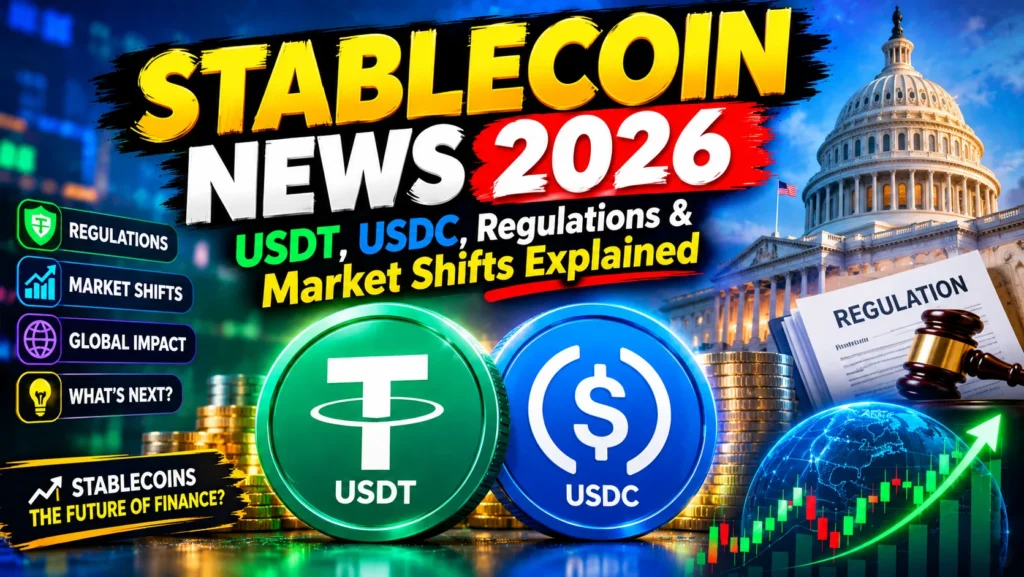
Stablecoin News 2026. If you told someone three years ago that the U.S. Treasury would be strategizing about how to export Tether and Circle, they’d think you were crazy. But that’s where we are.
Stablecoins used to be just a tool for crypto traders to sit out volatility. You’d sell your Bitcoin, go into USDT, wait. Simple. Now it’s a full-blown political and financial story. Washington, Brussels, Singapore everyone is fighting over how to regulate them. If you actually use USDT or USDC – to trade, to send money home, to pay people you need to know what’s shifting. Because a lot is shifting, fast.
Stablecoin News 2026
The Market Right Now: It’s Still Tether’s World
Let’s be honest about the numbers. USDT is still king. About 59% market share. USDC is second with roughly 23%. Add them together and they own over 80% of the entire stablecoin market. Everything else combined is just noise.
That’s good for liquidity. You can move $10 million in USDT on Binance and barely move the price. But it’s also risky. When 80% of the market depends on two companies, if one of them sneezes, the whole crypto market gets a cold.
What started as just a trading tool is changing though. I’m seeing more people use stablecoins for actual payments. A freelancer in Pakistan getting paid by a client in the US in USDC on Solana. A business using it to settle invoices. Stripe even said AI agents will start using stablecoins to pay each other for data. It’s moving beyond crypto.
The Biggest Change: The U.S. Finally Made a Law
For years the complaint was “there’s no clarity.” That’s over.
The GENIUS Act was signed in July 2025. It’s the first federal law in the US that specifically says what a payment stablecoin has to be. It doesn’t fully kick in until January 2027, but the Fed already dropped its proposed rules on how it will work.
And they’re pretty strict, in a good way.
First, full backing. For every 1 USDC you hold, Circle has to have $1 sitting in super safe assets – mostly short-term US Treasuries. Not commercial paper, not crypto, not loans. Real safe stuff. 100%.
Second, they have to grow up. Capital requirements, proper risk management, real compliance programs. Basically, if you want to issue a dollar on the internet, you have to act like a bank.
Stablecoin News 2026. Third, and this annoys a lot of people they can’t pay you interest. The law specifically says Tether and Circle cannot give you yield just for holding USDT or USDC in your wallet. They want it to be digital cash, not a savings account.
For you and me, that should make things safer. Less chance we wake up to news that reserves are missing. But it also means a lot of smaller stablecoins that can’t afford all this compliance are going to disappear.
Why Everyone Is Talking About USDT And Iran
Stablecoin News 2026. This is the ugly part. A U.S. Senate investigation subcommittee just put out a report titled “Tether Tied to Terrorism.” It’s brutal.
They went through 846 crypto wallets that were sanctioned by OFAC and by Israeli authorities from 2021 to 2026, all linked to Iran and related groups. Guess what they found? 84% of them were using USDT as their go-to stablecoin. Breaking it down further – out of 757 wallets flagged by Israel, 87% were primarily USDT. Out of 101 flagged by the U.S., 57% were primarily USDT. The report also claims two individuals moving Iranian oil moved over $603 million in USDT between 2021 and 2025.
Senator Blumenthal said USDT is basically a “highway” for Iran to dodge sanctions.
Stablecoin News 2026. Tether’s response? They said look, we froze around $550 million linked to Iran’s central bank just this year. And because everything is on a public blockchain, it’s traceable which is actually better than pallets of cash. They also said they work with the FBI and Secret Service constantly.
So what’s the truth? Probably in the middle. USDT is the most liquid, so of course bad actors use it – just like they use dollars. But the political pressure on Tether right now is very real, and if you hold a large amount of USDT, you can’t just ignore that.
Meanwhile, USDC Is Minting Like Crazy
While Tether is in front of Congress, Circle is minting. Stablecoin News 2026.
- On October 1st alone, they minted 250 million USDC on Solana. In the previous 24 hours, total was 750 million. For 2026 alone, they’ve minted something like $98.8 billion USDC on Solana.
- Why Solana? Two words: cheap and fast. A transaction costs less than a cent and settles in seconds. Ethereum is still great, but if you want to do payments, Solana makes more sense right now.
- Circle’s whole strategy is to be the opposite of Tether. “We’re the compliant one. We’re audited monthly. We’re US-based. Institutions can trust us.” And when USDT gets bad press, that strategy works.
The New Kid: OpenUSD
Late September, a new stablecoin dropped that most people missed, but it’s backed by giants.
It’s called OpenUSD, OUSD. It’s issued by Bridge, which Stripe bought. And the founding partners? Visa, Mastercard, Shopify, Stripe, and Coinbase. That’s not a normal crypto launch.
The interesting part is how they split the money. Tether and Circle keep all the interest from the Treasuries backing their coins. That’s how they make billions. OpenUSD is doing it differently – they share that revenue. If Visa helps OUSD grow, Visa gets paid based on how much OUSD supply and activity they drive. They claim over time, the “overwhelming majority” of the equity will go to partners.
Details so far: Issued by Bridge, owned by Stripe. Lives on Base, Ethereum, Solana, and Tempo. Reserves are held at Black Rock, Lead Bank, and BNY Mellon. You can trade it on Coin base, Kraken, Uni swap. And there’s no fee to mint or redeem.
But if you’re in Europe, hold on. OUSD is NOT MiCA compliant yet. Their Luxembourg company has an e-money license, but I checked the ESMA register – there’s no white paper filed for OUSD. So technically, it’s not supposed to be offered as a regulated e-money token in the EU right now.
Will it work? Depends. Will Visa and Mastercard actually push it to their merchants, or is this just a press release? We’ll know by looking at its circulating supply in a few months.
Also Check: Ethereum Staking Guide 2026: How to Earn Rewards & Risks Explained
The U.S. Wants The World To Use Dollar Stablecoins
This one surprised me. Bloomberg reported that the Treasury Department and State Department are actively working on a plan to push dollar stablecoins abroad through private companies.
Why would the government want that?
Stablecoin News 2026. Treasury Secretary Bessent laid it out pretty bluntly. One, it keeps the dollar as the world’s reserve currency. The dollar is still in almost 90% of global FX trades. Two, it creates a massive new buyer for U.S. government debt, because every stablecoin has to hold T-bills. Three, it gives people who don’t have bank accounts a way to hold dollars.
Stablecoin News 2026. The downside? The IMF and BIS are already warning. If everyone in Nigeria or Turkey or Argentina starts using USDC instead of their local currency, that could cause capital flight. And it makes it harder for those governments to control their own economies.
Stablecoin News 2026: What The Big Banks Are Warning About
The Bank for International Settlements and OECD have both said, hey, slow down.
BIS says stablecoins have two flaws: They can break. USDC fell to $0.87 when Silicon Valley Bank collapsed in March 2023. USDT fell to $0.90 in 2018. And earlier this year in January, USDT shot up to $1.40 on some P2P exchanges when demand went crazy. So much for always $1.
And they fragment money. A dollar should be a dollar, no matter where you hold it. But a USDT is not the same risk as a USDC or an OUSD. That breaks a basic principle of money.
OECD’s worry is more about financial stability. Stablecoin issuers now own so many T-bills that if everyone redeems at once, they have to sell those T-bills quickly, which could mess with bond yields. Plus, unlike your bank deposit, stablecoins have no insurance. No FDIC. If they fail, you get in line in bankruptcy court.
Where I Actually See Them Being Useful
Stablecoin News 2026. Despite all the risks, I use them almost every week because they solve real problems:
- Sending money home. A friend sending money from Dubai to India via bank transfer pays 6% and waits 2-3 days. Sending USDC on Solana? A few cents, 2 seconds.
- Trading. Still the main use. You need a stable base pair to trade in and out of volatile coins.
- Business payments. I know agencies that pay remote teams in USDC and the team cashes out locally. Way faster than SWIFT.
- AI stuff. This sounds sci-fi, but BlackRock mentioned it and it makes sense. When AI agents start transacting with each other thousands of times a day for compute and data, they aren’t going to use ACH. They’ll use stablecoins.
Mistakes People Keep Making
- Thinking USDT = USDC. They aren’t. Different companies, different reserves, different transparency, different regulatory risk. Treat them differently.
- Ignoring delistings. Over 40 tokens were delisted from EU exchanges because of MiCA. Your favorite stablecoin could be next if it doesn’t get licensed.
- Thinking it’s risk-free. It’s not insured. It’s not a bank account. If the issuer messes up, you could lose money.
- Chasing cheap fees on shady chains. You save $1 on fees using some random bridge, then lose $10k because the bridge gets hacked.
- Forgetting taxes. In many countries, trading USDT for USDC is a taxable event. Keep records, because tax agencies are getting serious about this.
How I Use Them Safely
- I split. I never hold everything in one stablecoin. Some USDT for liquidity, some USDC for safety.
- I only buy on regulated exchanges.
- I actually read the attestation reports. Circle puts one out every month. Tether does too now.
- And I keep a spreadsheet of every transaction. Boring, but it saves you later.
What I’m Watching Next
- January 2027 – GENIUS Act goes live. How strict will the U.S. actually be?
- The Clarity Act – still stuck in the Senate. It decides who regulates crypto, SEC or CFTC.
- Europe – MiCA enforcement is just starting. Who else gets delisted?
- OpenUSD – will it have $100M or $10B in circulation by January? That tells you everything.
- And Tether – does that Senate report turn into a real DOJ investigation? That’s the one that could move markets.
Frequently Asked Questions
What is the difference between USDT and USDC, really?
USDT is bigger, more liquid, everywhere. USDC is smaller but more transparent and U.S.-regulated. Traders like USDT, institutions and fintechs tend to prefer USDC.
Are stablecoins safe to hold?
Safer than Bitcoin for short-term value, but not as safe as dollars in a bank. They can depeg, they aren’t insured, and they depend on the issuer being honest about reserves.
What is the GENIUS Act in simple terms?
U.S. law passed in 2025 that says: if you issue a stablecoin, you must back it 100% with safe assets, follow bank-like rules, and you can’t pay holders interest directly. Starts Jan 2027.
Why is USDT in trouble with the Senate?
Senate investigators found sanctioned Iran-linked wallets heavily used USDT, alleging Tether didn’t do enough to stop it. Tether says it froze funds and helps law enforcement.
What is Open USD?
New stablecoin from Stripe’s Bridge, backed by Visa, Mastercard, Shopify, Coin base. Its twist is revenue sharing partners who help it grow get a cut of the profits.
Can I earn interest on stablecoins anymore?
Not directly from the issuer under new U.S./EU rules. But you can still lend them on DeFi platforms like Aave or use exchange earn products – just with extra risk.






4 Comments