ChatGPT vs Claude vs Gemini 2026
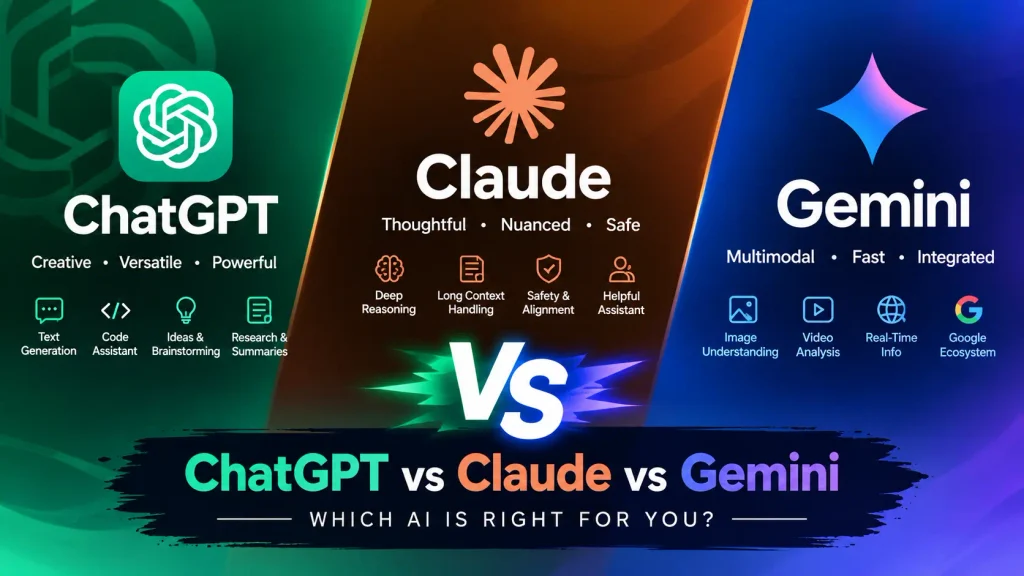
ChatGPT vs Claude vs Gemini : Which AI Model Fits Your Workflow in 2026? . The AI race has never been more competitive or more confusing . Every few weeks a new model drops, benchmarks shift and someone on social media declares a winner . But if you’re trying to get actual work done, you don’t need hype . You need to know which tool fits your specific workflow. That’s exactly what this ChatGPT vs Claude vs Gemini comparison will help you figure out.
I’ve spent months testing all three platforms across real tasks : writing, coding, research and business workflows. Here’s the honest breakdown, without the fanboyism.
The Short Version: Nobody Wins Everything
Let’s cut through the noise first. All three platforms are genuinely excellent in 2026 . The differences aren’t about which one is “smartest” they’re about fit. As one developer put it after months of testing : “All three are good. All three will occasionally embarrass you with a confidently wrong answer . The differences aren’t about which model is ‘smarter.’ They’re about fit”.
That said the differences absolutely matter. Let’s break them down.
ChatGPT vs Claude vs Gemini
OpenAI’s ChatGPT remains the most widely adopted AI assistant, and for good reason. It’s the Swiss Army knife of AI tools. ChatGPT vs Claude vs Gemini.
Where ChatGPT Excels
Breadth of capabilities . ChatGPT handles text, images, voice, web research, data analysis and even computer automation. If you need one tool that does a bit of everything, this is it . As one comparison noted “ChatGPT has fewer dead ends . A conversation can move from a normal question to web research, spreadsheet analysis , image creation, voice or a longer agent task without changing products”.
Enterprise features. Recent releases have pushed hard into business territory . GPT-5.4, for example, scored 87.3% on investment banking modeling tasks and 91% on legal document evaluation benchmarks. Open AI also claims its newest models are “33% less likely to be false and full responses 18% less likely to contain errors compared to the previous generation”.
Tool search efficiency. One underrated feature : GPT-5.4 dynamically discovers and retrieves only the tool definitions it needs cutting token usage by 47% while maintaining accuracy. For anyone building agentic workflows that’s a meaningful cost saver. ChatGPT vs Claude vs Gemini.
Where ChatGPT Falls Short
Coding depth. While competent, ChatGPT typically trails Claude on complex, multi file coding tasks. On SWE bench the benchmark developers actually care about GPT-5.5 scored 58.6% versus Claude’s 64.3%.
Cost at scale. Chat GPT’s flagship API pricing runs $4 per million input tokens and $20 per million output tokens for GPT-5.6 Sol. That adds up quickly for heavy users. ChatGPT vs Claude vs Gemini.
Occasional over eagerness. ChatGPT sometimes tries to do too much, generating verbose responses when a concise answer would suffice.
Claude: The Craftsman’s Tool
Anthropic’s Claude has carved out a reputation as the thinking person’s AI less flashy, more precise. ChatGPT vs Claude vs Gemini.
Where Claude Excels
Coding and code review. This is Claude’s strongest territory. On SWE bench Verified, Claude Opus 4.7 leads with 64.3%, roughly ten points ahead of Gemini. Developers consistently report that Claude “actually reads” the full context and produces code that accounts for edge cases. As one developer explained : “If you’re wiring up auth flows, database schemas, permission logic, anything where a subtle mistake becomes a production incident at 2 a.m., Claude will actually check whether the logic covers the edge cases before it hands you code”.
Writing quality. Claude is widely regarded as the best writer of the three. It’s less prone to turning every answer into a bulleted list and maintains a more natural, focused tone. For long form editing and revision workflows it’s the preferred tool. ChatGPT vs Claude vs Gemini.
UI and frontend work. Claude models have been “really good at UI and consistently beat the other two models” since Opus 4. Other open weight models are actually distilled from Claude for this purpose.
Where Claude Falls Short
Cost : Claude is the most expensive option by a meaningful margin. Claude Fable 5.1 runs $10 per million input tokens and $50 per million output tokens. Even the more affordable Sonnet 5.5 sits at $2/$10. ChatGPT vs Claude vs Gemini.
Limited multimodal capabilities : Claude can’t generate raster images only SVGs . If you need image generation, you’ll need to look elsewhere.
Stubbornness : Once Claude locks onto an approach, redirecting it can take more prompt-wrangling than the task warrants. ChatGPT vs Claude vs Gemini.
Gemini : The Speed and Value Play
Google’s Gemini has evolved rapidly, leveraging Google’s infrastructure and ecosystem.
Where Gemini Excels
Context window and speed : Gemini 3.1 Pro offers a 2-million token context window double Chat GPT’s 1 million. Its Flash models are blazing fast with Gemini 3.8 Flash hitting 499 tokens per second output speed. ChatGPT vs Claude vs Gemini.
Cost efficiency : Gemini 3.1 Pro is the cheapest frontier model at $2 per million input tokens. For budget conscious developers and businesses running high volume tasks, this matters enormously. ChatGPT vs Claude vs Gemini.
Multimodal native support : Gemini handles text, images, audio and video natively not as separate tools bolted on. For workflows involving video analysis or audio processing, this is a significant advantage. ChatGPT vs Claude vs Gemini.
Google ecosystem integration : If your business runs on Google Workspace, Gemini integrates directly into Docs, Sheets and Gmail, creating seamless workflows that standalone tools can’t match.
Where Gemini Falls Short
Coding performance. Despite Google’s own Android Bench showing Gemini 3.1 Pro leading at 72.4%, independent benchmarks place Gemini behind Claude and sometimes GPT on general coding tasks. On SWE bench , Gemini 3.1 Pro scored 54.2% a full ten points behind Claude.
Writing polish. Gemini’s writing can feel slightly more formulaic than Claude’s. It’s competent but rarely described as the “best” for creative or nuanced writing.
Agentic task reliability. While improving Gemini’s autonomous task execution still trails Chat GPT’s computer use capabilities and Claude’s long horizon agentic work.
Head to Head Comparison Table
| Category | ChatGPT | Claude | Gemini |
|---|---|---|---|
| Best For | All-purpose use, image gen, research | Coding, writing, code review | Budget tasks, multimodal, Google ecosystem |
| Coding (SWE-bench) | 58.6% | 64.3% (leader) | 54.2% |
| Context Window | 1M tokens | 1M tokens | 2M tokens |
| Multimodal | Text, image, audio | Text, image only | Text, image, audio, video |
| Input Pricing (flagship) | $4/M tokens | $10/M tokens | $2/M tokens |
| Writing Quality | Good | Best | Good |
| Image Generation | Yes | SVG only | Yes |
| Free Tier | Yes | Yes | Yes |
Practical Use Cases: Which Tool for Which Task?
For Content Writers and Bloggers
Claude wins for long form writing, editing and revision. Its ability to maintain voice and focus makes it the better drafting partner. One comparison noted that Claude “is easier to keep focused on a draft” and “often feels less eager to turn every answer into headings and checklists”.
But ChatGPT is better for research heavy content that requires web browsing and fact checking. Its Deep Research feature is more mature.
For Developers
Claude for production code. The consensus among developers is clear: Claude produces more reliable, edge case aware code for backend logic, authentication flows and complex refactoring.
ChatGPT for quick prototyping. When you need something working fast and don’t care about perfection, ChatGPT’s Codex integration is capable and widely supported across IDEs.
Gemini for Android and Google Cloud. If you’re building for Google’s ecosystem, Gemini’s native integration and Android specific optimization make it the pragmatic choice.
For Business and Operations
ChatGPT for breadth. Its enterprise features Excel add ins, FactSet integration, computer use make it the most versatile option for general business workflows.
Gemini for cost sensitive scaling. At $2 per million input tokens, Gemini is the cheapest frontier option for high volume processing tasks.
Claude for quality critical outputs. When accuracy matters more than cost legal documents, compliance reviews, customer facing content Claude’s precision justifies its premium.
For Researchers and Students
Gemini for multimodal research. Video analysis, audio transcription and massive context windows make it ideal for processing diverse source materials.
ChatGPT for deep research reports. Its Deep Research workflow produces comprehensive, well organized research summaries.
Claude for literature review. Its ability to maintain coherence across long documents and spot inconsistencies makes it valuable for academic work.
Common Mistakes When Choosing an AI Model
Chasing benchmarks instead of testing your use case. A five point lead on an unrelated benchmark is trivia. Run your own prompts through each tool before deciding.
Assuming one tool must win. The smartest approach is often using multiple tools. As one reviewer noted, “If you’re a power user and rely on AI as work infrastructure, using both is the best option”.
Ignoring API costs until the bill arrives. Token efficiency varies dramatically. GPT 5.4, for example, uses 47% fewer tokens through tool search, while Claude Sonnet models can be 76% more token efficient at medium effort.
Switching tools every week. The AI landscape shifts constantly but constantly migrating workflows has real productivity costs. Pick a tool that works use it until it genuinely stops serving you, then reconsider.
Tips for Getting the Most Out of Each Tool
ChatGPT Tips
- Use Projects to maintain context across related conversations.
- Leverage tool search if building agentic workflows it cuts token costs significantly.
- Try Deep Research for comprehensive reports rather than asking for information piecemeal.
Claude Tips
- Feed the full context upfront. Claude excels when it understands the complete picture before generating output.
- Use Projects for long term writing and coding work separate workspaces keep instructions and files organized.
- Try Artifacts for interactive mini apps and shareable code snippets.
Gemini Tips
- Exploit the context window. Load entire documents or codebases rather than chunking them.
- Use native multimodal input for video and audio analysis don’t convert to text first.
- Integrate with Google Workspace for seamless Docs, Sheets and Gmail workflows.
Also Check : Best AI Tools 2026: Free AI Tools
The Verdict: It Depends on You
After all the benchmarks and comparisons, here’s the honest truth : there is no single “best” AI model in 2026. The right choice depends entirely on what you’re optimizing for.
- Choose ChatGPT if you need versatility, image generation and the broadest feature set in one package.
- Choose Claude if code quality, writing precision and careful reasoning matter most.
- Choose Gemini if you need speed, cost efficiency, massive context and native multimodal capabilities.
And if you’re serious about productivity? Use more than one. Route research tasks to ChatGPT, coding to Claude, and high volume processing to Gemini. The tools are complementary not competitive.
Frequently Asked Questions (FAQs)
Which is better for coding: ChatGPT, Claude or Gemini?
Claude generally leads for production quality code and complex refactoring. ChatGPT is solid for quick prototyping and IDE integration. Gemini is competitive for Android development specifically.
Which AI model is cheapest?
Gemini 3.1 Pro is the cheapest frontier model at $2 per million input tokens. Chat GPT’s Luna tier is even cheaper at $0.20/M for lighter tasks.
Can Claude generate images?
No. Claude can generate SVG graphics but cannot produce raster images like JPGs or PNGs. ChatGPT and Gemini both offer image generation.
Which has the largest context window?
Gemini 3.1 Pro leads with a 2 million token context window. ChatGPT and Claude both offer 1 million tokens.
Are free versions of these tools worth using?
Yes, all three offer capable free tiers. They’re good for testing and light use but paid plans unlock better models, higher limits and advanced features.
Which is best for writing?
Claude is widely considered the best pure writing tool. It maintains voice better and is less formulaic than competitors.
Can these tools browse the web?
ChatGPT and Gemini have robust web browsing and deep research features. Claude’s web access is more limited but improving.
Which is best for business use?
ChatGPT offers the broadest enterprise feature set. Gemini wins on cost efficiency at scale. Claude is best for quality critical outputs.
Your Turn
Which AI model fits your workflow best? Have you tried all three, or are you loyal to one? Share your experience in the comments below I’d love to hear what’s working for you.
If you found this comparison helpful, share it with someone who’s still trying to figure out which AI tool to commit to. And subscribe to NordsVault for more practical tech breakdowns without the hype.





One Comment