AI Coding Assistant & Vibe Coding 2026
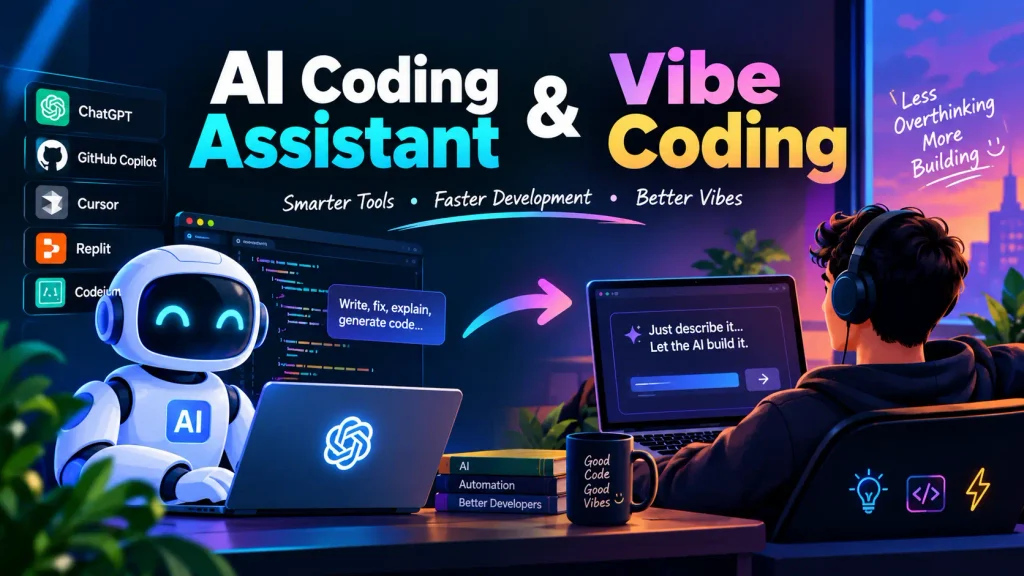
AI Coding Assistant & Vibe Coding Guide 2026 : Benefits Risks & Best Practices . The way we build software is changing faster than ever . Gone are the days when every line of code required manual typing . Enter the era of the AI coding assistant and a revolutionary approach called vibe coding . This shift is transforming how developers work, how businesses build products and how beginners enter the world of programming.
If you have been hearing about tools like Cursor, Claude Code or GitHub Copilot but are unsure where to start, you are in the right place . This guide will walk you through everything you need to know about AI assisted development and vibe coding in 2026 . We will explore what these concepts mean , how they work in practice and the critical limitations you must understand before diving in .
What Is an AI Coding Assistant?
An AI coding assistant is a software tool that uses large language models to help developers write, review debug and optimize code . Think of it as an intelligent pair programmer that never gets tired.
These tools integrate into your development environment whether that is your code editor your terminal or even your browser and respond to natural language prompts . You can ask them to generate a function explain a complex codebase and suggest a fix for a bug or write tests for your latest feature.
Popular AI coding assistants in 2026 include :
- Cursor : An AI first code editor built on VS Code foundations
- Claude Code : Anthropic’s terminal based coding agent
- GitHub Copilot : Now evolved into a broader agentic platform
- Zed : A high performance editor with built in agentic workflows
The fundamental promise is simple : instead of searching for syntax or writing boilerplate manually, you describe what you want and the AI generates the code .
Understanding Vibe Coding: The New Paradigm
The term “vibe coding” was coined by Andrej Karpathy in February 2025. In a now famous social media post, he described it as a style of programming where “you fully give in to the vibes, embrace exponentials, and forget that the code even exists” . AI Coding Assistant & Vibe Coding.
The concept spread rapidly. By November 2025, Collins Dictionary named “vibe coding” its Word of the Year, recognizing it as a cultural phenomenon that captured the evolving relationship between humans and technology .
What Vibe Coding Actually Means
At its core, vibe coding means building software by describing what you want in plain English (or any natural language) and letting AI generate the implementation . The defining characteristic, according to Karpathy’s original definition is that the coder does not need to understand how or why the code works. You accept that some bugs and glitches will be present . AI Coding Assistant & Vibe Coding. AI Coding Assistant & Vibe Coding.
However, there is an important distinction between two interpretations of vibe coding:
Pure vibe coding (as Karpathy originally described) : You prompt you run the output you copy and paste errors back and you iterate without reading the actual code . This works for weekend prototypes and throwaway experiments . AI Coding Assistant & Vibe Coding.
Structured vibe coding (how most professionals practice it) : You use AI to generate code but you review every diff run comprehensive tests and maintain human oversight of critical paths. As one guide puts it, “The word ‘vibe’ in the name should not suggest lack of rigor. Effective vibe coding is disciplined iteration” .
Why Vibe Coding Is Gaining Traction
The numbers tell a compelling story. According to a 2026 Agoda developer report, 55% of developers now save at least seven hours per week using AI tools, a dramatic jump from just 18% in 2025 . The usability of AI generated code has also improved significantly with 62% of developers saying output is usable without major modifications. AI Coding Assistant & Vibe Coding.
Anthropic’s 2026 trends report described this shift as “the most significant paradigm shift since the graphical interface,” suggesting that we are moving toward a world where “anyone can become a developer” .
How Vibe Coding Works: The Practical Workflow
If you are ready to try vibe coding, understanding the workflow is essential . Here is how experienced practitioners approach it . AI Coding Assistant & Vibe Coding.
The Core Loop: Prompt Generate, Review and Refine
The fundamental cycle of effective vibe coding follows four steps :
- Prompt with specific intent : Describe what you want to build, including constraints, tech stack and expected behavior.
- Generate the output : Let the AI produce code, tests or documentation.
- Review every line : This is non negotiable. Read the diff carefully.
- Refine through follow up prompts or manual edits : Iterate until the code meets your standards. AI Coding Assistant & Vibe Coding.
Setting Up Your Context for Success
One of the most important skills in AI assisted development is context management. When the AI loses track of your project conventions or file relationships, output quality degrades rapidly .
Most tools provide mechanisms for this:
- CLAUDE.md files for Claude Code
- .cursorrules for the Cursor IDE
- AGENTS.md files for general agent configuration
These files tell the AI about your project’s architecture coding standards and constraints. Treat them as first class documents review them in pull requests and update them when conventions change . AI Coding Assistant & Vibe Coding.
A Realistic Example
Imagine you need to build a REST API endpoint for creating tasks . Instead of writing the code manually, you might prompt : AI Coding Assistant & Vibe Coding.
“In the tasks controller, implement a POST endpoint that accepts a title and description , validates that title is not empty and does not exceed 200 characters saves to the database using the existing Task model and returns the created task in the standard response envelope.”
The AI will generate the implementation. Your job is then to review it for edge cases (what if the database is down? what if title contains only whitespace?) security concerns (is input properly sanitized?) and consistency with your existing patterns .
Key Benefits of AI Coding Assistants
The productivity gains from AI coding tools are well documented. A 2026 developer survey found that 56% of developers say AI tools have positively impacted their productivity, with benefits concentrated in several areas :
- Faster code generation : Boilerplate is CRUD operations and repetitive patterns can be generated in seconds rather than minutes.
- Quick debugging assistance : AI can often identify issues and suggest fixes faster than manual searching.
- Reduced documentation burden : AI can generate docstrings for comments and README files automatically .
- Learning acceleration : When working with unfamiliar APIs or languages, AI acts as an always available tutor .
- Rapid prototyping : Ideas can be tested and iterated in hours instead of days.
- For businesses these gains translate to faster time to market and the ability to experiment with more ideas . For individual developers and it means spending less time on tedious work and more time on architecture and problem solving.
Critical Limitations and Risks You Must Understand
Despite the hype and genuine utility, AI coding assistants have serious limitations . Ignoring these can lead to technical debt security vulnerabilities and production failures.
The Trust Gap Is Real
Here is a striking statistic : while 87% of developers now use AI coding tools, only 31% trust the accuracy of AI generated output . Just 4% report having “high trust” in AI generated code .
This trust gap exists for good reason . Developers have learned through experience that AI generated code requires careful verification.
Common Failure Modes
Research and developer reports highlight several recurring problems :
- Hallucinated dependencies : AI models sometimes reference npm packages that do not exist or API methods that have been deprecated. This is especially common in longer sessions where context drifts.
- Variable naming inconsistencies : One file might define a variable as
phone, while another usesphone_number. Data type mismatches occur as well. - Security vulnerabilities : The model may generate queries vulnerable to SQL injection, expose environment secrets in error responses or skip authentication checks on new endpoints.
- Architectural incoherence : As one analytical report describes it : “Vibe coded systems exhibit local coherence but global incoherence. The codebase becomes an archaeological artifact reflecting prompt history rather than designed architecture” .
- The “Hollow Senior” problem : Engineers with years of AI assisted experience who can generate complex systems but lack strong debugging intuition when agents fail .
When Vibe Coding Breaks Down
Some problems are fundamentally unsuited for AI only approaches:
- Complex state machines with intricate transition logic
- Performance critical algorithms where optimization matters
- Security critical paths like authentication and authorization flows
- Novel or undocumented APIs with no training data available
- Distributed systems where consistency and concurrency require formal reasoning
Recognizing when AI slows you down rather than speeding you up is itself a valuable skill.
Best Practices for Effective AI Assisted Development
If you want to leverage AI coding assistants without creating a maintenance nightmare, here are the practices that work.
1. Always Review the Diff
This cannot be overstated. Read every line of AI generated code before committing. The most dangerous failure mode is accepting code without understanding it. If the code compiles and basic tests pass but you cannot explain how it works, you are building on unstable ground .
2. Pin Your Dependencies
Verify every import against actual installed packages. Run npm ls <packagename> to confirm a package exists. Cross reference package.json to catch packages referenced in code but never declared as dependencies .
3. Use Context Files
Create and maintain AGENTS.md, CLAUDE.md, or .cursorrules files that document your project’s conventions, forbidden actions and architectural decisions. A practical benefit : writing these documents forces your team to articulate conventions that often exist only in senior engineers’ heads . AI Coding Assistant & Vibe Coding.
4. Implement Mandatory Human Review
For authentication, authorization, data access and any code handling sensitive operations, require human review before deployment. The Agoda report found that 79% of developers report requiring human approval for production deployment and this is the right approach .
5. Test Edge Cases Explicitly
AI generated tests often miss edge cases . Prompt the agent to generate tests specifically targeting boundary conditions, error states and failure modes . Then review those tests a test that validates wrong behavior is worse than no test at all .
6. Know When to Type Code Yourself
Not everything benefits from AI generation. Complex algorithms, security critical paths and performance sensitive inner loops are cases where manual coding is often faster and safer .
Vibe Coding and the Future of Developer Skills
The rise of AI coding assistants is reshaping what it means to be a developer. Anthropic’s 2026 report suggests that the role is shifting from “code writer” to “agent orchestrator” .
Skills That Matter More Than Ever
- System architecture and design : Understanding how components fit together and making decisions about trade offs.
- AI literacy : Knowing what AI can and cannot do and how to prompt effectively.
- Agent orchestration : Managing multiple AI agents, reviewing their output and directing their work.
- Debugging intuition : The ability to reason about systems when AI generated code fails.
Skills That Are Diminishing in Value
Pure syntax memorization and the ability to write boilerplate quickly are less valuable than they once were. As the Anthropic report states, “those who only know how to write code will gradually be eliminated from the market” .
This shift creates anxiety, particularly for junior developers. The Agoda report found that 49% of junior developers feel less secure about their future career prospects, compared to just 17% of CTOs and VP Engineering respondents .
Practical Tips for Getting Started
- If you are new to AI coding assistants, here is how to begin without getting overwhelmed.
- Start with a side project : Use vibe coding for a weekend prototype or personal tool. This gives you a safe environment to learn the workflow.
- Choose one tool and learn it deeply : Whether it is Cursor, Claude Code, or Copilot, understanding one tool well beats shallow familiarity with many.
- Build your prompt library : Save effective prompts categorized by task type : scaffolding, CRUD generation, debugging, refactoring, testing.
- Keep sessions focused : If a conversation drifts across multiple unrelated features, start fresh with a focused prompt and pinned files . AI Coding Assistant & Vibe Coding.
- Review, review, review : The productivity gain comes from offloading syntax translation and not from skipping engineering judgment.
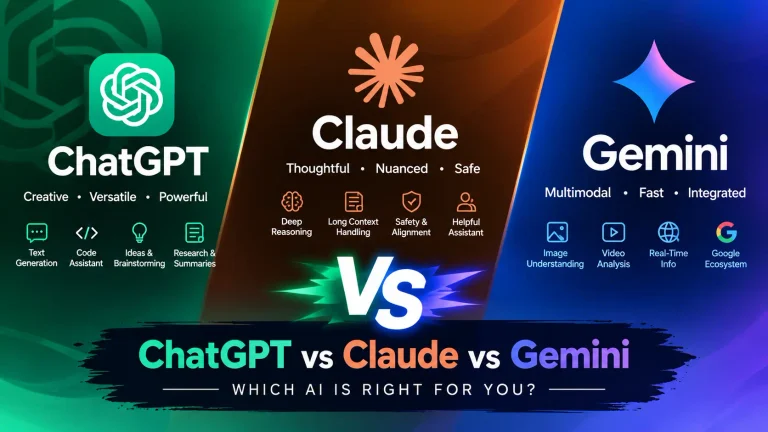
Also Check : ChatGPT vs Claude vs Gemini 2026
Common Mistakes to Avoid
Trusting without verifying : Never ship AI generated code you do not understand.
Ignoring context management : When the AI starts contradicting earlier decisions, it is time to reset context.
Letting agents run wild : Configure permission boundaries. A bug-fixing agent and a deployment agent should not have the same access .
Skipping security review : Integrate static analysis tools and manually review all authentication and data access paths. AI Coding Assistant & Vibe Coding.
Believing the hype : AI is a powerful assistant and not a replacement for engineering judgment.
Frequently Asked Questions (FAQ)
What exactly is vibe coding?
Vibe coding is a development approach where you describe what you want in natural language and let AI generate the code. The term was coined by Andrej Karpathy in February 2025 to describe fully embracing AI suggestions without deeply reviewing the code .
Is vibe coding safe for production applications?
Pure vibe coding where you do not review the code is not suitable for production systems, especially those handling sensitive data or security critical operations . Structured vibe coding with rigorous review can be safe for many production use cases .
Which AI coding assistant is best in 2026?
There is no single “best” tool. Claude Code leads in developer satisfaction for complex reasoning tasks, while Cursor and GitHub Copilot offer different strengths . The right choice depends on your workflow, budget and specific needs .
Can AI coding assistants replace human developers?
No. AI is a productivity multiplier, not a replacement. Human judgment remains essential for architecture, security, debugging complex issues and understanding business requirements . Anthropic’s report suggests roles are shifting, not disappearing .
How much does an AI coding assistant cost?
Pricing varies widely. GitHub Copilot Pro is $10/month , Cursor offers a free tier with paid plans around $20/month and Claude Code pricing depends on usage . API costs for building custom integrations range from $2 to $20 per million tokens depending on the model .
What is the biggest risk of vibe coding?
The biggest risk is shipping code you do not understand . This leads to security vulnerabilities, technical debt and systems that become impossible to maintain or debug when problems arise .
How do I manage context when working with AI coding agents?
Use context files like AGENTS.md or CLAUDE.md to document project conventions . Start fresh sessions when conversations drift. Pin relevant files to ensure the AI has the information it needs .
What types of projects are best suited for vibe coding?
Prototypes, internal tools, personal projects, and features with well established patterns (CRUD operations, form validation, standard API endpoints). Avoid using pure vibe coding for security critical or performance critical systems .
How do I review AI generated code effectively?
Read every line of the diff. Check for security vulnerabilities, edge cases, and consistency with your codebase. Run the full test suite. If you cannot explain what the code does, do not ship it .
Will AI coding assistants get better?
Yes, capabilities are improving rapidly. However, the fundamental need for human review and judgment is unlikely to disappear. The skill is learning to work effectively with AI as a collaborator .
Conclusion
The AI coding assistant revolution is real, and vibe coding has become a legitimate approach to software development when practiced with discipline . The productivity gains are genuine, but so are the risks.
The developers who will thrive in this new era are not those who blindly trust AI output or those who refuse to adapt . They are the ones who use AI as a powerful tool while maintaining the engineering judgment that only humans can provide.
Whether you are building a weekend prototype or shipping production software, the key is finding the right balance : leverage AI for speed and scale but never surrender your responsibility for code quality and security.
What has your experience with AI coding assistants been like? Have you tried vibe coding for your projects? Share your thoughts in the comments below and if you found this guide useful, pass it along to a fellow developer.