Solana Price and Ecosystem 2026: Drivers, Upgrades, and Risks
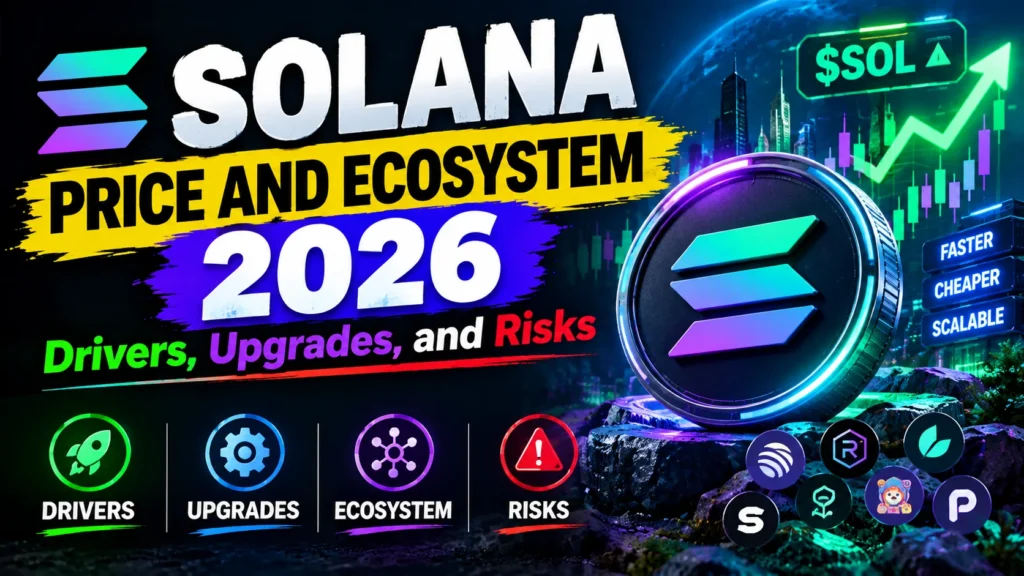
Solana Price and Ecosystem 2026. If you’ve followed crypto for more than a year, you know Solana is never quiet.
One minute people are calling it dead after an outage, the next minute it’s doing more transactions than every other chain combined. That’s Solana for you. And right now in 2026, it’s having one of those comeback moments again.
After dropping all the way down to around $62 back in June, SOL is back above $120 as we close out September. That’s almost a 2x bounce in just three months. But honestly? The price is the least interesting part of what’s happening. Under the surface, the network itself is changing fast.
Let’s actually look at what’s driving it.
Solana Price and Ecosystem 2026 What’s Actually Driving the Solana Ecosystem
Price action gets the headlines, but the real story is happening on-chain. Solana is processing more transactions than ever, and the composition of that activity is slowly changing.
Network Activity Is Breaking Records
In August 2026, Solana processed a record 5.2 billion non-vote transactions, with a median fee of just $0.00046 . That’s roughly as many daily transactions as all other tracked chains combined, at a fraction of the cost. The network also led all Layer 1s with $397 million in application revenue from May through August .
Stablecoins and Tokenized Assets Are Growing Fast
Stable coin supply on Solana reached an all-time high near $17.3 billion in September, up from around $15 billion in August . This matters because stable coins are the lifeblood of DeFi activity more liquidity means more trading, lending, and borrowing.
Tokenized real-world assets (RWAs) are also expanding rapidly. RWAs on Solana (excluding stablecoins) grew from $2.3 billion in April to $4.1 billion in August . Tokenized equity supply reached $518 million, with cumulative trading volume passing $9.7 billion . Projects like Kamino are building credit infrastructure around these assets, with over $21 billion in on-chain loans originated over three years .
Institutional Interest Is Growing
U.S. spot Solana ETFs have recorded multiple consecutive weeks of net inflows, with more than $360 million entering the products over a 10-week period . In one standout week in late September, ETFs pulled in $188 million, with Bitwise’s BSOL alone capturing $128 million . Exchange supply has been falling as ETF demand rises over 3 million SOL left exchanges in September alone .
This is still a relatively small piece of the overall market, but the trend is clear. Institutions are paying attention.
The Infrastructure Upgrades Changing Solana’s Future
Solana’s reputation in its early years was defined by two things: incredible speed and occasional embarrassing outages. The network has worked hard to fix the second part, and several key upgrades are now in various stages of rollout.
Firedancer: A Second Client for Resilience
Firedancer, developed by Jump Crypto, is an independent validator client designed to run alongside the existing Agave client. It’s now live on mainnet and has processed tens of millions of transactions, though the rollout is intentionally gradual .
Why does this matter? Before Firedancer, Solana relied on a single dominant client. If that client had a bug, the whole network could suffer. Firedancer adds diversity — and it borrows architecture from traditional high-frequency trading systems, which should help with performance under heavy load .
The team has been cautious about expanding too fast. As Firedancer’s lead engineer put it, “We don’t want everybody to run it yet” . That patience is probably wise, but it also means the full benefits will take time to materialize.
Alpenglow and Faster Finality
The Alpenglow consensus upgrade is designed to cut transaction finality from around 8 seconds to approximately 150 milliseconds . That’s a dramatic improvement that could make Solana more competitive for payments, trading, and other time-sensitive applications. Alpenglow is currently live on public testnet and expected to activate on mainnet in Q4 2026
Where Is SOL Price Right Now?
As I’m writing this in late September 2026, SOL is sitting around $120-$122. It’s been banging its head against $124-$130 for weeks – every time it tries to break out, sellers show up.
Here’s the snapshot:
- Current price is about $120. The low in June was around $60. All-time high is still $293 from back in the day. Market cap is sitting near $70.7 billion, and it’s doing $6 to $7 billion in daily volume.
- So yeah, it’s recovered hard from the June bottom, but it’s still down a lot from its peak. That’s important to remember.
- Traders I follow are watching two levels very closely. $115 is acting like a strong floor – about 26 million SOL last changed hands around there, so a lot of people have their cost basis there.
- If that breaks, the next stop could be $105. On the upside, if SOL can finally close a daily candle above $130, most charts point to $150-$160 pretty quickly.
- It’s stuck in that range for now. No clear breakout yet.
The Real Story Is On-Chain, Not On The Chart
Price gets clicks, but if you want to know if a chain is healthy, you look at what people are actually doing on it.
And on Solana, people are doing a lot.
- In August alone, Solana processed 5.2 billion real transactions – not validator votes, actual user transactions.
- The median fee? $0.00046. Less than a tenth of a cent. To put that in perspective, that’s more daily activity than all the other major chains added together.
- It also made more money than anyone else. From May to August, Solana apps pulled in $397 million in revenue. That’s more than any other Layer 1.
- So the usage is real.
Two Big Things Are Growing Fast: Stablecoins and Real-World Stuff
First, stablecoins. This is huge. Stablecoin supply on Solana hit an all-time high in September – about $17.3 billion, up from $15 billion just a month before in August. Why should you care? Because stablecoins are fuel. When there’s more stablecoin liquidity, DeFi works better. More trading, more lending, more everything.
Second, tokenized real-world assets, or RWAs. This is not just meme coins anymore. Excluding stablecoins, RWAs on Solana jumped from $2.3 billion in April to $4.1 billion in August. Tokenized stocks alone hit $518 million, with almost $10 billion in total trading volume. Platforms like Kamino have already done over $21 billion in on-chain loans in the last three years.
This is the shift people wanted to see – from pure speculation to actual financial stuff living on-chain.
Institutions Are Finally Coming In
This is new for Solana. For years it was a retail chain. Now institutions are showing up through ETFs.
US spot Solana ETFs have seen 10 straight weeks of inflows – over $360 million in total. One week in late September was wild, $188 million came in, and $128 million of that went into just one fund, Bitwise’s BSOL.
You can see the effect. In September alone, over 3 million SOL left centralized exchanges. When ETF demand goes up and exchange supply goes down, that’s usually a good setup. It’s still early, but the trend is obvious – Wall Street is no longer ignoring Solana.
The Tech Upgrades That Actually Matter
Solana used to be famous for two things: being insanely fast, and randomly going offline for hours. They’ve spent the last two years trying to fix the second part.
Firedancer – The Backup Client
For a long time, Solana only had one main validator client, Agave. If that client had a bug, the whole network was at risk. Firedancer, built by Jump Crypto, is a completely separate client.
It’s live on mainnet now and has already processed tens of millions of transactions. The team is being super careful though – they don’t want everyone switching at once. As the lead engineer said himself, “We don’t want everybody to run it yet.” Smart move. It adds resilience and it’s built like a high-frequency trading system, so it should handle crazy load much better.
But we won’t see the full benefit until way more validators run it.
Alpenglow – Making It Feel Instant
This is the one I’m most excited about. Right now, Solana takes about 8 seconds to fully finalize a transaction. Alpenglow is supposed to cut that down to 150 milliseconds. That’s basically instant.
Imagine using Solana for actual payments at a store, or for trading where every millisecond counts. That’s what Alpenglow is for. It’s on public testnet right now and should hit mainnet in Q4 2026.
Fixing Inflation – Less New SOL Coming
Solana has no hard cap like Bitcoin, so inflation matters. In August, validators passed proposal SGP-0002, which doubles how fast inflation goes down – from 15% a year to 30% a year. The final inflation rate will still be 1.5%, but we’ll get there by 2029 instead of 2032.
That change alone removes about 18.9 million SOL that would have been created by 2032. For holders, that’s a big deal. Less dilution.
What Are People Predicting for SOL Price?
Look, nobody knows. But here’s what the big names are throwing out:
Standard Chartered is the most bullish – they have $135 for end of 2026, $400 for 2027, and a wild $2,000 by 2030. That $2,000 call assumes Solana becomes the go-to chain for payments and real-world finance, not just memes. They’ve also changed their targets a bunch of times before, so take it with a grain of salt.
Polymarket, where people bet real money, is more cautious. There’s a 59% chance priced in for $140 by end of 2026, but only a 12% chance for $200. So traders think $140 is possible, $200 is a stretch.
Other analysts like Ali Charts are saying if $115 holds, $160 is on the table. Surf Research is calling for a retest of the all-time high in their base case.
Bottom line: predictions are all over the place. Don’t bet your house on any of them.
Let’s Be Real About The Risks
I like Solana, but it’s not all sunshine.
It’s still a memecoin chain for revenue. In August, out of $13.4 million in total protocol fees, $4.9 million came from Pump.fun alone. That’s more than a third from one memecoin launchpad. For Solana to be worth way more long-term, it needs fees to come from payments, DeFi, and those RWAs we talked about, not just memes.
Competition is brutal. Ethereum L2s are getting cheaper, and other fast chains aren’t standing still. Solana DEXs still lag behind in things like perpetual futures open interest and order book depth. Speed alone isn’t enough.
The tech still has to prove itself. Yes, Solana has had 100% uptime since February 2024, which is a massive improvement. But Firedancer is still rolling out slowly for a reason – they are worried about stability. Alpenglow isn’t on mainnet yet either.
And macro matters. In 2026, every time Treasury yields spiked or stocks sold off, SOL got hit hard. Crypto doesn’t live in a bubble. If the overall market goes risk-off, strong fundamentals won’t save the price short-term.
So What Should You Actually Do With This Info?
- If you’re a developer, investor, or just curious, here’s how I look at it:
- Don’t just stare at the price. Watch ETF flows, watch stablecoin supply, watch how much RWA volume is happening, watch fee revenue. That tells you if the network is actually healthy.
- Pay attention to governance votes. Stuff like SGP-0002 changes the economics of your investment directly.
- And please, manage risk. Solana is still down about 40% over the past year even after this rally. It’s volatile. Only put in what you can actually afford to lose.
- The most important thing to watch in the next 6 months is whether Solana can move beyond memes. If stable coins, tokenized stocks, and payments keep growing, that’s the real bull case. If it stays just a casino for meme coins, the ceiling is lower.
Frequently Asked Questions
What is Alpenglow?
Alpenglow is a consensus upgrade that aims to reduce Solana’s transaction finality from 8 seconds to approximately 150 milliseconds. It’s currently on test net .
What is Firedancer and why does it matter?
Firedancer is an independent validator client developed by Jump Crypto. It adds redundancy to Solana’s network and is designed to improve performance under heavy load .
What are Solana’s key support and resistance levels?
Support sits around $115 and $105. Resistance is in the $124–$130 zone, with $150–$160 as a potential target if that breaks .
What is the current Solana price?
As of late September 2026, SOL is trading around $120–$122 .
Why has Solana’s price gone up recently?
Several factors: strong ETF inflows, record network activity, growing stablecoin supply, and anticipation of infrastructure upgrades like Firedancer and Alpenglow .
Final thought
Solana in 2026 feels like it’s at a crossroads. The price is back, usage is at all-time highs, and the tech is finally maturing. But the question that will decide the next two years is simple – can it become more than just the fastest chain for speculation and become actual financial infrastructure?
The next few months Alpenglow launch, ETF flows, and whether that $124-$130 resistance breaks – will tell us a lot.
What do you think? Are you bullish on Solana here or do you think it’s getting overhyped again? Drop your take below.




One Comment