Best Altcoins to Buy in 2026
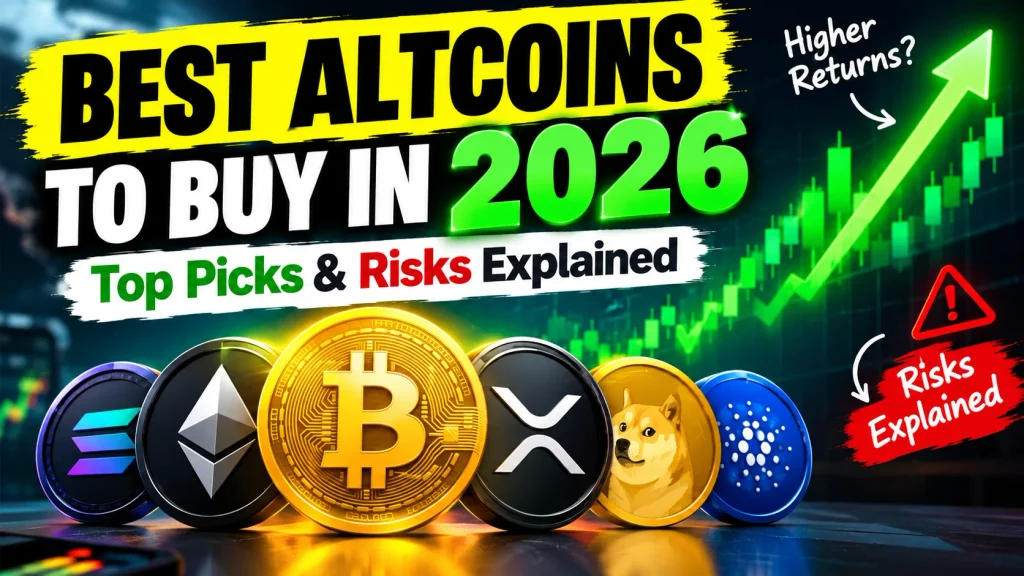
Best Altcoins to Buy in 2026. The crypto sector is evolving. The era of buying any token with a crazy name and seeing it rocket is quickly coming to a close. In 2026, the best altcoins to buy aren’t necessarily the hottest tokens in Twitter.
They are projects that make money, pay out their users and even fix real issues people care about. If you’re trying to find the best altcoins to buy in 2026, you need a different approach than you did in 2021. In this guide, we examine the projects that creating long-term value, the narratives bringing money into the space, and the risks you simply must understand.
Quick Disclaimer This is not financial advice. Consult a professional if you need investment advice. Cryptocurrency investing can be very risky and volatile, so never invest any amount you can’t afford to lose.
Best Altcoins to Buy in 2026.The Big Shift: Why 2026 Is Different
It’s only a part of the equation. The last bull market was about the story. A token could do 500% based on a whitepaper and a charming CEO. That’s the past.
And now, analysts are keeping an eye on something else: cash flow. It’s already known that the markets aren’t yet experiencing a full altcoin season, with crypto trader Dennis Liu arguing in October 2026 that the average altcoin sits just 10% above Bitcoin since its bottom. The coins that are pumping are those with fundamentals.
What’s the significance of that for you as an investor? It means the best altcoins to buy in 2026 will be the ones you hold because of buybacks, burns, or staking rewards. As you can imagine, projects without that are growing increasingly hard to justify.
Bitwise CIO Matt Hougan captured the nuance when talking about the emergence of tokenization. When you buy a tokenized stock, you are not making yourself rich by tokenization. You might be by owning the infrastructure that allows it.
The Top Altcoins to Watch in 2026
The table below compares the projects covered in this guide using data from September 2026 where available. Prices move constantly, so treat these figures as reference points, not current quotes.
| Project | Ticker | What It Does | Key Metrics (Sept 2026) |
|---|---|---|---|
| Ethereum | ETH | Largest smart contract platform | $303B market cap |
| Solana | SOL | High-speed Layer 1 | $60B market cap |
| Hyperliquid | HYPE | On-chain perpetuals exchange | $18.9B market cap |
| Chainlink | LINK | Oracle infrastructure | $9.5B market cap |
| Aave | AAVE | DeFi lending protocol | $2.04B market cap |
| Bittensor | TAO | Decentralized AI network | $2.49B market cap |
Now let us look at each one in detail.
Ethereum and Solana The Infrastructure Layer
Ethereum and Solana are the places where all the real economic activity is in crypto. They’re not the sexiest names, but they’re the foundation of everything else.
Why Ethereum Still Matters
Will Ethereum Continue to Dominate? Out of all ecosystems, Ethereum will continue to be the largest DeFi ecosystem by far. Its defi asset footprint amounts to approximately $49 billion, and it has the lion’s share of real-world on-chain assets.
The case for Ethereum in 2026 is not for the fastest and cheapest. It is for the most secure and trustworthy. Whenever institutions tokenize a bond, real estate, or an equity, it is customary for them to launch their contracts with ETH as the baseline due to trust assumptions being the most road-tested.
Real world use case: Get exposure to the tokenisation trend if you don’t want to pick your own DeFi tokens by taking the most macro position on the cryptocurrency market.
Solana’s Speed Advantage
With Solana, you can buy and sell transactions faster and cheaper than on Ethereum. That’s crucial for two expanding industries: Payments to AI agents and high-frequency trading.
Coinbase CEO Brian Armstrong has said AI agents will outperform all humans combined on transactions – in the future. At that point, the networks processing those transactions need to be cheap and fast. Solana hopes to be that network. The size of the ecosystem that is built on its platform – the defi asset footprint – has already surpassed Ethereum’s at just over $6 billion, and is growing.
The honest limitation: An outdated network, but up to date Solana has gotten higher, however, it is nonetheless a possibility Ethereum does not face.
Hyperliquid: The Revenue Machine
The one altcoin that made us view altcoins differently in 2026 is Hyperliquid.
Hyperliquid is a decentralized perpetual futures exchange. However, everyone’s talking about it because of its tokenomics – which most other tokens would probably love to have. Almost 99% of the trading fees are used to purchase HYPE tokens on the open market, which are then burned forever.
Since launch, the protocol has bought and then burned (taken out of circulation) more than $2 billion worth of HYPE, or 4.7% of its max supply. To put that into perspective, that’s around four to five times the burn rate of Ethereum.
The token is trading at around $85-$90 market cap stands at close to $19 billion. An analyst on Trading View set bullish targets of $200 and $300, but with a notable caveat. To pump the price to $300, Hyperliquid would require $5 billion in annual revenues – which would be more than seven times where Hyperliquid is now. That’s “an enormous hurdle,” the analyst said.
What this means for you: Hyperliquid is a genuine business. However the obvious upside may already be discounted. It’s quite possible that smaller projects with the same Model might offer a greater percentage of growth.
The DeFi Revenue Plays Aave, Injective, and Pendle
Best Altcoin to Buy in 2026 #2: Revenue sharing DeFi tokens The second of the best altcoins to buy in 2026 will be DeFi protocols that reward holders of the tokens with revenue. This is a newer trend and is gaining a lot of attention.
The Lending Leader
What is Aave? Aave is the largest lending protocol in DeFi. Geoffrey Kendrick, head of digital assets research at Standard Chartered, predicted that the price of AAVE will reach $3,500 by 2030 because of its reputation as an on chain banking leader.
The reasoning is simple. More real-world assets on-chain = more participants having to borrow against those assets. And it’s on AAVE that they’ll borrow. With revenue directly linked to that borrowing, it stands to reason that growth in DeFi lending should be good for AAVE value.
Injective Buyback and Burn
Injective is designed for on-chain financial markets, such as perpetuals and tokenized assets. As part of its monthly revenue, it repurchases and destroys, or “burns,” its own INJ tokens. To date, it has burned more than 7 million tokens.
An analyst cited by Coinpedia has set value areas for INJ of $50 and $90. The first would return it close to the previous high while the latter would value the project at around $10 billion.
Trading Future Yield
What Pendle does: Pendle allows you to divide a yield-bearing asset in two, into principal and yield. These two components can then be traded independently.
Around 80% of Pendle’s fees are used to buy PENDLE back. All stakers are paid out bi-weekly. The analyst’s $8 target would place Pendle slightly higher than its previous ATH of $7.50. He said the project would require roughly $60 million in yearly revenue to support such a level.
The Bridge Between Blockchains and Reality
Bitwise CIO Matt Hougan provided a helpful analogy for Chainlink. “A blockchain is like a spreadsheet on your computer, with no Internet connection. It can handle calculations, but it can’t see stock prices, bond prices, or currency values unless it has a link to the outside world.”
Chain link is that link. It has a roughly 70% to 80% share of the market for plugging blockchains into real world data. When more assets move on chain, nearly all of them will be requiring Chain link, or a variant thereof.
Hougan estimated Chainlink’s valuation at $6 billion to $7 billion, “relatively modest” for a project that might serve as the foundation for global markets for “decades or centuries.”
Practical example: Spot Chainlink ETFs launched in December 2025. They have posted zero net weekly outflows in the face of sullen markets, Hougan said. It means that institutional investors are aware of the thesis.
The AI Bet
Death by a thousand cuts: AI and crypto are colliding, and Bittensor is the best way to get exposure.
What is Bittensor? Bittensor is a network of subnets that provide AI training and other services. A recent upgrade seeded each subnet with a token of its own, and the top subnets, such as Chutes, continuously buy back their subnet tokens with platform revenue.
Bittensor, with a market cap of about $2.49 billion and a max supply of 21 million tokens is smaller and riskier than some of the other options on this list. But it also has more potential for growth if AI remains as prominent a story as it is today.
Common mistake: Thinking the token is Bittensor, and buying due to “AI is hot” hype. Bittensor isn’t an AI product. It’s a marketplace. Most of the value runs to the subnets that actually do something useful.
Aerodrome and the Base Ecosystem
Aerodrome is the primary protocol for trading on Coinbase’s Base network. It has processed a total volume of $185 billion and generated $270 million in swap fees as of April 2026.
Tokens that stake their tokens may vote on distribution of pools’ rewards, and receive a share of exchanges’ revenues. The token is close to $0.80, with $3.50 and $6 to $8 targets for analysts.
Market: Aerodrome has announced a merger with Velodrome. Final terms may be altered and the amount of tokens issued, which may impact the economics.
How to Evaluate Any Altcoin in 2026
- Buybacks/Burns/Revenue sharing: If fees are collected solely by the validators or treasury, token holders are not receiving any direct compensation.
- Transaction volume, fee revenue, and number of users. The combination of low usage but a very high market cap can be ominous.
- Unlocking in big chunks applies sell pressure. See when is the next big unlock date.
- There is a higher chance that projects with a developer community will endure the bear market.
- Every investment has a bear case. Write yours before you buy.
Risks You Cannot Ignore
- Crypto is not a safe investment. The risks involved in 2026 are real.
- It could be that altcoin season does not arrive. According to Dennis Liu in October 2026, “altcoins are nowhere near a full season”, and attempting to purchase alts only after Bitcoin reaches a new high proved unsuccessful in 2024. Don’t expect 2021 to repeat itself.
- Quantum computing is a future threat. In February 2026, BIP-360 was approved as an initial step for quantum resistance. Failure to upgrade the networks means that over time the wallets’ encryption will be broken.
- Tokenomics can also be altered. Mergers, governance votes and additional emissions can dilute holders. Read the proposals.
- Uncertain regulation. Countries take very different approaches to crypto. What is permissive now may not be tomorrow.
- You can loose everything. Never add money that you don’t have that is not in your budget.
Common Mistakes to Avoid
- Running after pumps. When a token is up 500% in a week, you are late. The best entries are usually boring.
- Not considering the unlock schedule. One time when a large unlock is in store for next month is a potential time bomb.
- Overspending coins.30 coins in an altcoin portfolio are impossible to follow. Select a handful you understand.
- Not securing your gains. Unrealized profits vanish in a flash. How do you plan to book profits?
- Following influencers. Influencers don’t need to be paid. Almost all of them shilling a coin have an interest.
Practical Tips for Building a Position
If you’re interested in buying altcoins, here is a quick guide.
- Begin with modesty. Use position sizes that you can risk losing completely.
- Dollar-cost average. Invest a fixed dollar amount at regular intervals rather than attempting to identify the bottom.
- Don’t mix spot and trading A crypto trader called Ansem explained: “If you wanna separate your emotions, you have to clear and separate your spot. Perpetuals and high risk on chain are their own bucket.
- Stake where you can. Many of these tokens have staking rewards. If you are bullish on the project in the long term staking can be a way to increase your position.
- Check Quarterly The crypto market is fast. What was logical in January may not be logical in July.
For More : Best Altcoins to Buy in 2026
Frequently Asked Questions
What are the best altcoins to buy in 2026?
Altcoins to watch for 2026 by revenue and user activity These altcoins are the most talked about by year. 2026 is in this list of altcoins to watch for 2026 Solana Ethereum Hyperliquid Chainlink Bittensor Aave.
Is 2026 a good year to buy altcoins?
It depends on your risk appetite and time horizon. Analysts say that altcoin season has not actually commenced, which some people interpret as a warning and others see as a positive. Use only the money you are prepared to lose.
Will altcoins outperform Bitcoin in 2026?
No one can say for sure. However, it can be noted that most altcoins have only mildly outperformed Bitcoin since its bottom, but not nearly as much as during previous altcoin seasons. Others in the community have speculated the upcoming altcoin season will be more curated.
What is the safest altcoin to buy?
Ethereum is generally considered the least risky altcoin due to its size, security, and institutional adoption. However, “safe” is relative in crypto. Even Ethereum can lose significant value.
Which altcoin has the best tokenomics?
Buyback and burn is what Hyperliquid is known for. The project takes nearly 99% of all trading fees and dedicates that revenue to buy back and burn its native coin, HYPE. Injective and Pendle also have effective buyback mechanisms.
What is tokenization and how is it important?
Tokenization is the digital representation of all real-world assets like stocks, bonds, and real estate on a blockchain. Standard Chartered estimates that $4 trillion worth of on-chain tokenized assets will be available by the end of 2028, with Ethereum, Solana, and Chainlink well set to benefit.