Cryptocurrency Wallet vs Digital Wallet: What’s the Difference? (2026 Guide)
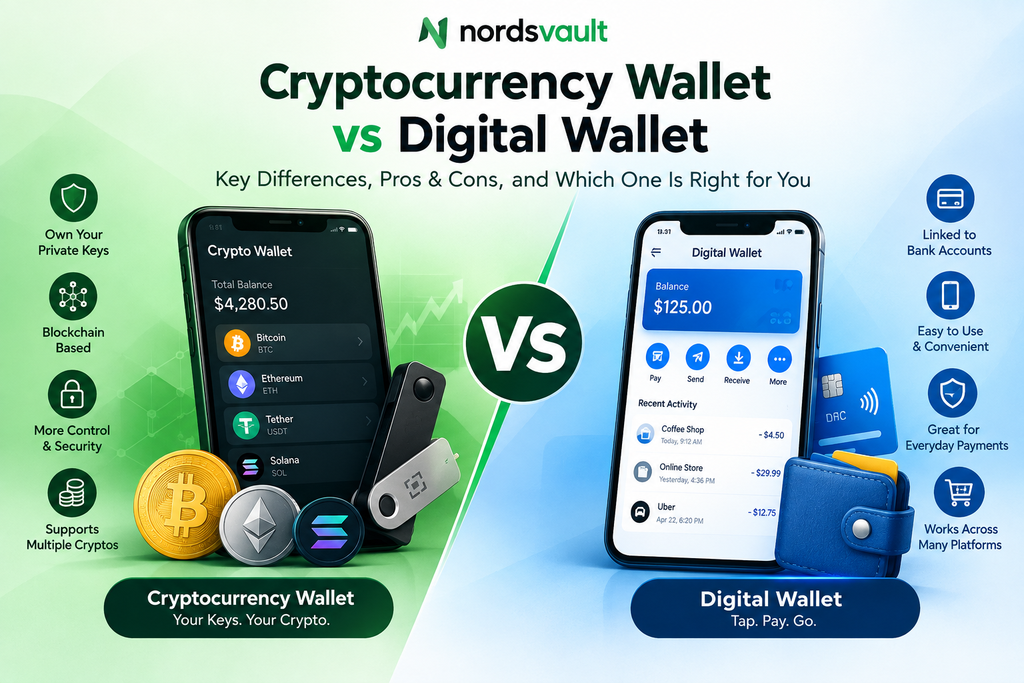
Cryptocurrency Wallet vs Digital Wallet may seem similar, but they serve very different purposes. A digital wallet is designed for everyday convenience using traditional money, backed by banks and regulatory frameworks. A cryptocurrency wallet grants you direct ownership and control over digital assets, but that control comes with greater responsibility and, if you aren’t careful, higher risk.
As financial technology continues to evolve, don’t be surprised if the two increasingly merge. For now, however, understanding the distinction helps you choose the right tool for the job and keeps your money, whether fiat or crypto, more secure in the process.
What Is a Digital Wallet?
A digital wallet (sometimes referred to as an e-wallet) is an app or platform that stores your traditional payment information such as debit cards, credit cards, and bank account details allowing you to make payments online or in person without using a physical card.
Popular digital wallets include:
- Apple Pay
- Google Pay
- PayPal
- Venmo
- Samsung Pay
When you use a digital wallet, you are still using standard fiat currency dollars, euros, pounds, etc. The wallet simply acts as a secure intermediary between your bank or card issuer and the merchant, often employing tokenization so that your actual card number is never directly shared.
What is a cryptocurrency wallet?
A cryptocurrency wallet, on the other hand, does not store traditional currency at all. Instead, it stores the private keys that grant you access to your cryptocurrency holdings such as Bitcoin, Ethereum, or other digital assets which actually reside on the blockchain rather than inside the wallet itself. Popular crypto wallets include:
- MetaMask
- Trust Wallet
- Ledger (hardware wallet)
- Coinbase Wallet
- Trezor (hardware wallet)
Unlike standard digital wallets, crypto wallets come in various types:
- Hot wallets Connected to the internet (apps, browser extensions); convenient but more vulnerable to hacking.
- Cold wallets Offline hardware devices; highly secure but less convenient for daily use.
- Custodial wallets A third party (such as an exchange) holds your keys.
- Non-custodial wallets You alone control your private keys, meaning you bear full responsibility for security.
Key Differences Between Cryptocurrency Wallet vs Digital Wallet
What they store
A digital wallets stores payment card details and bank information linked to fiat currency. A crypto wallet stores private keys that prove ownership of cryptocurrency on the blockchain—it does not actually “hold” the coins themselves.
Type of currency
Digital wallets deal exclusively with fiat currency (USD, EUR, INR, etc.). Crypto wallets deal with digital assets such as Bitcoin, Ethereum, and thousands of other cryptocurrencies and tokens.
Regulation and oversight
Digital wallets are typically regulated by financial authorities and linked to banks or card networks, offering built-in consumer protections such as fraud dispute resolution and chargebacks. Crypto wallets especially non-custodial ones generally operate outside traditional banking regulations, meaning there is less consumer protection if something goes wrong.
Responsibility for Security
With a digital wallet, your bank or wallet provider typically handles fraud protection, and lost funds can often be recovered. With a non-custodial crypto wallet, you are 100% responsible for your private keys. If you lose them or they are stolen, there is usually no way to recover your funds no customer support hotline can help.
Transaction Speed and Fees
Digital wallet transactions are usually processed in seconds and often come with low or no fees for personal use. Crypto wallet transactions depend on the speed and congestion of the blockchain network, and fees (known as “gas fees” on some networks) can fluctuate significantly.
Reversibility
Payments made via digital wallets can often be disputed, reversed, or refunded by the bank or wallet provider. Cryptocurrency transactions are generally irreversible once confirmed on the blockchain there is no “undo” button.
Similarities Between the Two
Despite their differences, both types of wallets share some common features:
- Both eliminate the need to carry physical cash or cards.
- Both use encryption and authentication (PINs, biometrics, passwords) for security.
- Both are accessible via mobile apps or browser extensions.
- Both are rapidly becoming part of everyday commerce, ranging from online shopping to in-store payments.
In fact, some modern wallets are beginning to blur the lines apps like Cash App and PayPal now allow users to buy, hold, and even spend specific cryptocurrencies, combining features of both types of wallets in one place.
Which One Should You Use?
The right choice really depends on what you are trying to do:
Choose a digital wallet if you:
- Want to make everyday purchases in your local currency.
- Prefer built-in fraud protection and easy refunds.
- Need a convenient, beginner-friendly way to pay online or in stores.
- Do not want to deal with cryptocurrency volatility.
Choose a cryptocurrency wallet if you:
- Want to buy, hold, or trade digital assets like Bitcoin or Ethereum.
- Are interested in decentralized finance (DeFi) or NFTs.
- Value having full control over your funds without relying on a bank.
- Are comfortable taking responsibility for securing your private keys.
For most people, using both makes sense a digital wallet for daily expenses, and a crypto wallet for investing in or exploring blockchain-based assets.
Security tips for both types of wallets
Regardless of which wallet you use, a few habits go a long way in keeping your money safe:
- Always enable two-factor authentication (2FA) where available.
- Never share your private keys, passwords, or PINs with anyone.
- Use only official apps download them from verified app stores.
- For large crypto holdings, consider a hardware (cold) wallet.
- Regularly update your apps to patch security vulnerabilities.
- Beware of phishing links pretending to be from your wallet provider.
Final Thoughts
Digital wallets and cryptocurrency wallets might sound similar, but they serve very different purposes. A digital wallet is built for everyday convenience with traditional money, backed by banks and regulation. A cryptocurrency wallet gives you direct ownership and control over digital assets, but with that control comes greater responsibility and greater risk if you’re not careful.
As financial technology keeps evolving, don’t be surprised if the two continue to merge further. But for now, understanding the difference helps you choose the right tool for the right job and keeps your money, whether fiat or crypto, safer in the process.
FAQs
Is a cryptocurrency wallet the same as a digital wallet?
No. A digital wallet stores traditional payment methods and fiat currency, while a cryptocurrency wallet stores the private keys needed to access and manage cryptocurrency on a blockchain.
Which is safer a digital wallet or a crypto wallet?
Digital wallets are generally considered safer for everyday users because they come with bank-backed fraud protection. Crypto wallets can be very secure too, especially hardware wallets, but they place full responsibility for security on the user.
Can I use a digital wallet to store cryptocurrency?
Some digital wallets, like PayPal and Cash App, now allow users to buy and hold limited cryptocurrencies, but they typically don’t give you full control over private keys the way a dedicated crypto wallet does.
What happens if I lose access to my crypto wallet?
If it’s a non-custodial wallet and you lose your private key or recovery phrase, your funds are usually unrecoverable. This is different from a digital wallet, where lost access can often be restored through customer support.
Do I need a crypto wallet if I don’t invest in cryptocurrency?
No. If you don’t plan on buying, holding, or trading cryptocurrency, a digital wallet is enough for everyday payments and transfers.