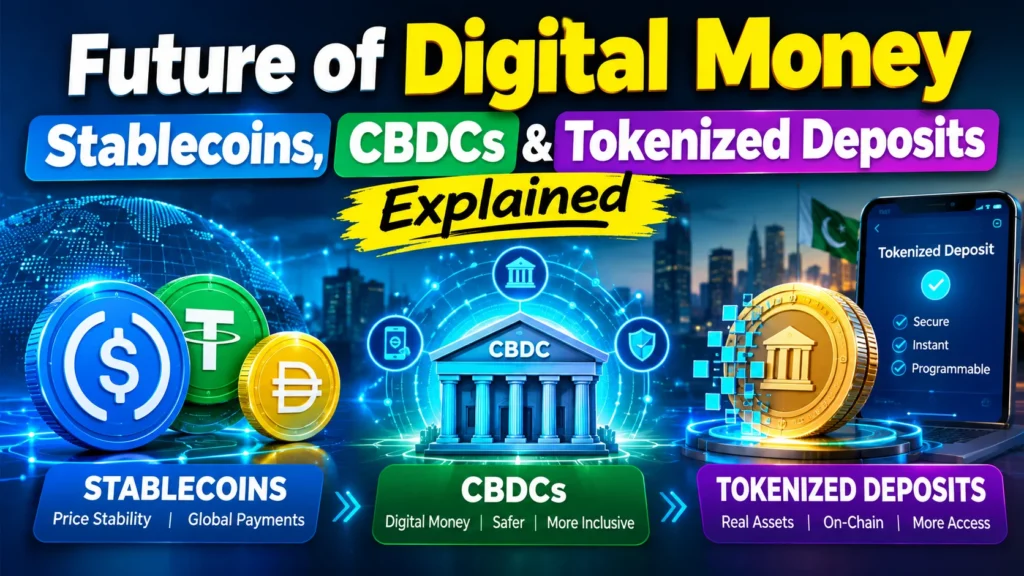
Future of Digital Money: Stablecoins, CBDCs & Tokenized Deposits Explained
Future of Digital Money. If you sent money abroad ten years ago, you remember the drill. You went to the bank, filled out forms, paid a fee that felt way too high, and then you waited. Three days, sometimes five. You had no real idea where your money was during that time.
Now? A freelancer in Manila can get paid by a startup in Berlin in under two minutes, on a Saturday night, for less than a dollar in fees. That’s not a prediction. That’s today. And it’s why we need to talk about digital money differently.
For a long time, digital money was a topic for crypto Twitter and central bank conferences. Not anymore. In 2026, it has become plumbing. The invisible stuff that makes business work. And the big question isn’t “will it happen?” anymore. It’s “which version of it will we actually end up using?”
Future of Digital Money: So, What Are We Even Calling “Digital Money”?
People throw this term around and mean totally different things. Your banking app shows a number. That’s digital. But that’s not what we’re talking about here. When insiders say digital money now, they usually mean money that lives on a blockchain meaning it can move instantly, it never sleeps, and you can actually program it to do things.
There are really three players to know:
- 1. Stablecoins: Think of these as digital dollars. Companies like Circle with USDC and Tether with USDT issue a token and promise it’s always worth one dollar. They back it with real reserves. It’s private money, pegged to public money.
- 2. Tokenized Deposits: This is the banks’ comeback. It’s your regular bank deposit, but instead of sitting in a slow, old database, it’s recorded on a blockchain. Same money, same bank guarantee, but it can move like a stablecoin. JPMorgan, Citi, and a group of 25 big US banks are all building this right now.
- 3. CBDCs – Central Bank Digital Currencies: This is government money, pure and simple. A digital note issued directly by a central bank. Like digital cash. China is furthest ahead with its digital yuan. The US, interestingly, has said no to this for everyday people.
Why does the difference matter? Because trust matters. With a stablecoin, you trust a private company. With a tokenized deposit, you trust your bank. With a CBDC, you trust the government. Three very different promises.
There Won’t Be One Winner. And That’s Okay.
I used to think one of these would win and kill the others. That was wrong.
Agustín Carstens, who runs the BIS basically the central bank for central banks said it best this year. The future will be diverse by design.
And it makes sense if you think about it. The money you use to buy groceries has a different job than the money Apple uses to pay a chip supplier in Taiwan. One needs to be simple and instant at the checkout. The other needs to handle millions, with complex conditions attached.
The real danger isn’t having too many types of digital money. It’s that they won’t talk to each other. If your USDC can’t move to my tokenized deposit without a complicated, expensive workaround, we’ve just rebuilt the same broken system we have today, just with fancier tech. Interoperability getting these systems to play nice is the whole game right now.
How Stablecoins Quietly Took Over Business Payments?
If you still think stablecoins are just for crypto traders flipping Bitcoin, you’ve missed the biggest shift in the last two years.
The real action is B2B. Business to business.
According to McKinsey’s latest tracking, about 58% of all real-world stablecoin payments are now companies paying other companies. Supply chains. Treasury management. Paying a factory in Vietnam from a headquarters in Germany. The volume is wild. In early 2024, we were looking at around $5 billion a month in these kinds of real payments. By early 2026, it’s over $30 billion a month.
Why did companies jump so fast? Because their pain was real. A normal international wire goes through a chain of correspondent banks. Each one takes a cut, each one adds a delay. It can take 1-5 business days and you have no clue about fees until the end. Stablecoins? You send it, it settles in minutes. You see the fee upfront. And it works at 10 PM on a Sunday.
- For a business paying 40 suppliers in 15 countries, that’s not a nice-to-have. That’s a massive operational win.
- But here’s the twist regular people are not really using them at the store yet.
- Consumer payments with stablecoins are still tiny. It’s a classic chicken-and-egg problem. I’m not going to bother setting up a wallet and learning about gas fees if my local coffee shop doesn’t accept it.
- And my coffee shop isn’t going to bother accepting it if none of its customers ask for it. Cards are just too easy.
- We’re also seeing the market split in half. This is fascinating. USDC is now handling about 70% of actual payment volume the business stuff even though USDT has a bigger total market cap.
It looks like this: Big companies and banks trust USDC more because it plays by the rules and is super compliant. But if you’re in Argentina or Nigeria and you just want to save in dollars because your local currency is unstable, you’re probably holding USDT. Two different tools for two different jobs.
The Banks Fight Back With Tokenized Deposits
- Banks watched stablecoins grow and thought, “We can do that, but better, and inside the regulated system.” And that’s tokenized deposits.
- The idea is simple. Your $10,000 at Chase is already just a number in their database. Why not put that number on a blockchain rail so it can move instantly and be programmable, while still being a Chase deposit with FDIC insurance and all the legal protections?
- In June this year, The Clearing House owned by the biggest US banks announced they are building a shared network to make tokenized deposits work with normal payments. They want it live in the first half of 2027. JPMorgan’s Kinexys is already moving billions every single day.
Also Check: Hot Wallet vs Cold Wallet: Which Is Safer in 2026?
The killer feature isn’t just speed. It’s programmability.
Imagine this: You’re a company that gets paid only when a container arrives at a port and is scanned. You can write that logic directly into the money itself. No invoice chasing. No manual release. The money moves itself when the condition is met.
Future of Digital Money. Or treasury automation if your account goes over $2 million, automatically sweep the extra into an interest-bearing account. That’s not a future concept. Banks are selling that right now.
As one payments executive told me, the tech is the easy part. Future of Digital Money. The hard part is deciding who gets access to this superpower and how much to charge for it.
What About Government Digital Money — CBDCs?
This is where it gets political.
Right now, 146 countries are exploring a CBDC. Four years ago it was 87. So almost everyone is looking at it. But almost no one has actually done it. Only three small countries have fully launched one for regular people. Future of Digital Money. The Bahamas, Jamaica, and Nigeria and honestly, adoption has been slow. People already have mobile money apps that work fine.
The big one to watch is China. Their digital yuan, e-CNY, is in a different league. By late 2025 they had done over 3.4 billion transactions worth around $2.3 trillion. Future of Digital Money. And earlier this year, they made it so you can earn interest on it. Even then, most people in China still just use Alipay and WeChat Pay.
Future of Digital Money. And then there’s the United States. The US has taken a completely opposite path.
In January 2025, the White House issued an executive order that basically said: no US retail CBDC. The argument was about privacy and financial stability the government doesn’t want to be able to see every transaction you make. Future of Digital Money. Instead, the US is betting on private, regulated stablecoins through a new law called the GENIUS Act. The idea is to let dollar stablecoins spread the dollar’s influence everywhere, without the government having to issue it directly.
That’s a huge philosophical divide. Future of Digital Money. Europe and Asia are exploring government digital cash. The US is saying, let the private sector do it, but we’ll regulate it.
For now, most of the serious central bank work isn’t even for you and me. It’s wholesale for banks settling huge amounts with each other across borders. Project Agorá, run by the BIS with 8 central banks and 40 big banks, is building a shared platform just for that. It’s less visible, but it’s where trillions move.
The Rules Are Finally Arriving
For years the excuse was “there’s no regulation.” That excuse is gone.
- Europe was first. Its big crypto law, MiCA, is now fully enforced as of this year. If you want to issue a stablecoin in Europe, you need real reserves, proper governance, and you have to tell customers exactly what’s backing it. They’re already working on MiCA 2.0 to cover DeFi.
- The US finally did something too. The GENIUS Act, signed in July 2025, is the first federal rule for payment stablecoins. Full backing, monthly disclosures. There’s another bill, the Clarity Act, trying to sort out who regulates what between the SEC and CFTC.
- Asia is moving fast as well. South Korea is piloting tokenized deposits for government spending with rules that can control what the money can be spent on and when. Canada now makes non-bank stablecoin issuers register with the Bank of Canada. Australia is expected to pass its own laws this year.
- The message from regulators everywhere is the same: if you are backed 1-to-1, transparent, and compliant, you have a future. If you’re not, you don’t.
Where You’ll Actually See This in Real Life
- This isn’t theory. Here’s how people are using it today:
- A supplier payment from Singapore to Brazil. Old way: 4 days, $45 in correspondent fees, bad FX rate. New way: USDC sent in 2 minutes, fee under $1, converted to Brazilian Reais locally.
- Paying a global team. A remote company with designers in Pakistan, developers in Poland, and writers in Kenya can pay everyone in stablecoins, and each person cashes out to their local bank. No more waiting for Wise or PayPal to clear.
- Smarter treasury. A CFO doesn’t want her team manually moving cash. She programs it. Money automatically moves to where it earns the most, or converts currency when the rate hits a target.
- Government aid. Instead of handing out vouchers, a government can send tokenized money that can only be spent on food or rent, and only this month. South Korea is testing exactly this.
The Honest Risks
- I’d be doing you a disservice if I didn’t mention the risks.
- Stablecoins are only as good as their reserves. Circle and Tether say they are fully backed, and audits suggest they are, but we have not seen what happens in a true financial panic. Can everyone redeem at once?
- There’s also no real consumer protection. If your bank fails, the government insures your deposit. If a stablecoin issuer fails, you have a contract that says you can redeem. That contract might be worthless in a bankruptcy court.
- For CBDCs, the risk is flipped privacy. If all your money is a direct liability of the central bank, in theory, the central bank could see everything you buy. That’s why the US said no.
- And regulation is still a patchwork. A stablecoin that’s legal in the EU might not meet US standards, and vice versa. If you’re a global business, that’s a headache.
Frequently Asked Questions
What is the future of digital money?
The future of digital money is going to be a multitude of different options, not a one-size-fits-all model. Stablecoins, bank deposit tokens, and CBDCs will coexist and will all have different use cases. But the path forward will be programmability–money with rules.
Will digital money replace cash?
Cash was on the decline in most advanced economies even before the rise of digital money. Even if CBDCs and stablecoins further hasten this trend, it is unrealistic to expect a cashless society in the short term. Several central banks intend to introduce CBDCs that coexist with cash.
Are stablecoins safe?
There is a difference in safety among stablecoins based on who issues them, what reserves are backing them and whether they are subject to regulation. Regulated stablecoins with fully backed reserves and transparent reporting are seen as lower risk. But they are not the same as bank deposits and do not have comparable safeguards
How do stablecoin and CBDC differ?
A private issued stablecoin is a coin issued by a private institution which is a claim on that private institution. A CBDC is a direct claim on the central bank. A CBDC is similar to paper currency and is a claim on the central bank.