Google Helpful Content Update 2026: What It Really Means for Your Website
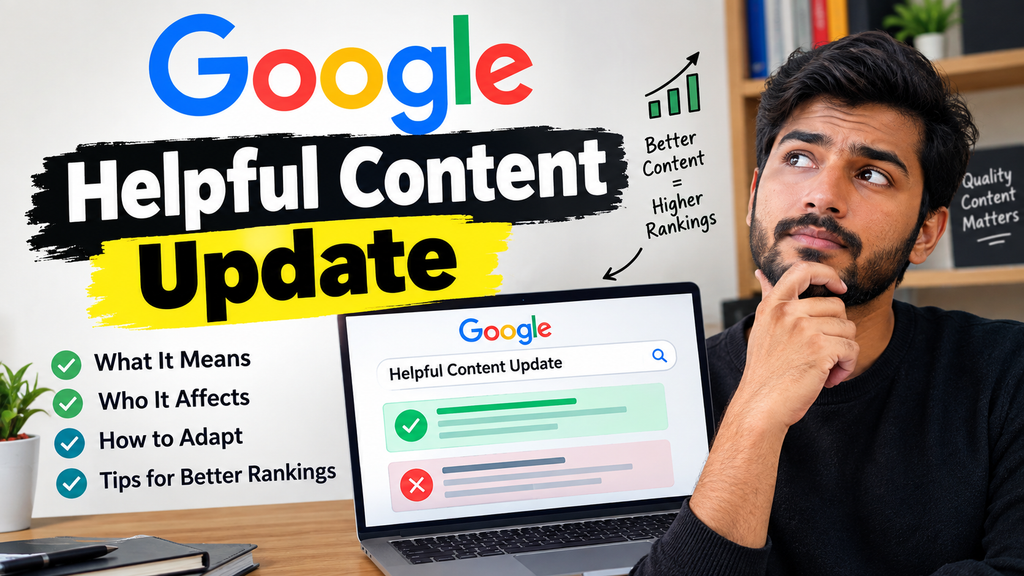
Google Helpful Content Update: What It Really Means for Your Website . Whether you own a website, blog, or online business, you’ve probably felt the ground shift beneath your feet in the last few years. One day your website traffic was steady; the next it was gone. Those pages that used to rank for years were nowhere to be found. And it was all because of a Google update, many people said.
But here’s the thing: most coverage of this update is focused on the wrong question. They ask, “How do I keep Google’s algorithm happy?” The question that matters is much simpler, and more critical: “Am I creating content that real people find really useful?” That’s the question that the Google helpful content update was meant to encourage-and, by implication, de-incentivize sites that simply obsess over rankings.
This guide explains what the update is, how it works now, what it means for your traffic & revenue and what you can actually do about it.
What Was the Google Helpful Content Update?
Helpful Content system rollout (2022) The Helpful Content system is a new ranking signal introduced in 2022 to help searchers find more original, helpful content made by people, for people, and to send less useful content to the bottom of the search results. It started as a site-wide signal, so when too much of your content is considered unhelpful, good pages on your site can still be impacted.
It wasn’t a manual penalty. Fully automated, using machine learning, and imposed at the site level rather than on individual pages. That distinction is important because there was nothing to ask to be ‘fixed,’ and no way to get a message in Search Console.
The core: Google set out to cut down on the thin content that might technically have answered a question, but didn’t leave searchers happy. Examples: Affiliate reviews that nobody had actually used the product for, or posts that just linked to what other publications said without offering any insight of their own.
A Major Shift: It’s Now Part of Google’s Core Algorithm
Here’s the most important thing you need to know about the Google helpful content update 2026: there is no helpful content update 2026.
In March 2024, Google announced that it had integrated the Helpful Content system into its core ranking systems. The separate “Helpful Content Update” updates halted. Now, the ideas of helpful content are baked into the standard core of Google’s ranking evaluations.
What does this mean practically?
There isn’t a “next Helpful Content Update” to sit and wait for, or recover from.
Usefulness is assessed on an ongoing basis, with updates happening during larger core updates.
You aren’t going to “undo” a helpful content hit with one quick fix. You’ll want to make better content treatment changes for your website over time.
The truth is, if you’ve already produced people-first, As Google’s documentation states,
What “Helpful Content” Actually Means (According to Google)
Google’s public guidance on what constitutes helpful content is summarized as a set of self assessment questions. These aren’t ranking factors – no checklist – but a common perspective from which the algorithm (and Google’s human quality raters) can view a piece of content.
The Content and Quality Questions
- Does the content provide original information, reporting, research, or analysis?
- Does it offer a substantial, complete, or comprehensive description of the topic?
- Does it provide insight beyond the obvious?
- If drawing on other sources, does it add substantial value rather than simply rewriting?
- Would you want to bookmark, share, or recommend this page?
- Would you expect to see this content in a printed magazine, encyclopedia, or book?
The People-First Questions
- Do you have an existing audience that would find the content useful if they came to you directly?
- Does the content demonstrate first-hand expertise and depth of knowledge?
- After reading, would someone feel they’ve learned enough to achieve their goal?
- Would someone leave feeling they’ve had a satisfying experience?
The Warning Signs of Search-Engine-First Content
- Is the content primarily made to attract search engine visits?
- Are you producing lots of content on many topics hoping some will perform?
- Are you using extensive automation to produce content on many topics?
- Are you mainly summarizing what others say without adding value?
- Are you writing to a particular word count because you heard Google prefers it?
If you answered “yes” to many of the warning signs, that’s your cue to reassess.
How E-E-A-T Connects to the Helpful Content System
What is the Google helpful content update? The helpful content update from Google isn’t the only thing there. It’s actually very much a part of the E-E-A-T-Experience, Expertise, Authoritativeness, and Trustworthiness-the system Google uses to rate the quality of pages.
The first “E” (Experience) was included at the end of 2022, indicating that Google needed to find out whether the creator had really experienced the subject, instead of merely learning about it on paper. A product reviewer who has actually used the product. An explorer who has actually gone to the location. A blogger who has actually checked out the technique.
Note: E-E-A-T Is not a direct ranking factor. Google has been clear about this (several times). It is an evaluation framework for human quality raters, and the signals from those human evaluations are used to train the algorithms that determine rankings – but the net effect is clear: content that actually shows experience, shows expertise, and is transparent about trustworthiness – ranking well.
What doesn’t work:
- Signing articles with “Editorial Team” plus a generic bio
- Fictional author personas
- Hidden affiliate links without disclosure
- No author page, no About page, no way to verify who created the content
What Happened to Sites Impacted by the Update?
This was extremely messy post-Google helpful content update. Huge traffic drops for genuinely human-created content. Some recovered, many didn’t.
The Recovery Stories
That was until June 2025. Google rolled out another core update and almost two thirds of those websites that lost their rank in the last update experienced a recovery, reporting a weekly 20% increase from pre-update traffic levels. SEO industry expert Glenn Gabe dubbed these recoveries “the biggest surprise of this update” reporting that some sites “came back from the dead”.
House Fresh, a product review website, chronicled their two year comeback with a focus on brand-building via YouTube content and big-name partnerships rather than technical SEO. This is consistent with studies that found the update leaned more heavily on signals from the website’s brand than the quality of its content.
The Painful Lessons
Not all did well. Australian lifestyle site DMARGE blew $200,000 on SEO consultants, website improvements and content editing over a three-year period to their site. They reduced number of articles from 12,000 to 3,000, eliminated whole content types and spent huge sums on technical optimisation. Their traffic dropped from 8 million monthly visits to 300,000.
A UK gaming publisher GGRecon closed down entirely after failure to bounce back. A Spanish automotive portal lost 3 million monthly readership.
Google’s own team admitted the issue Google Search Liaison Danny Sullivan said at the October 2024 Web Creator Summit that many publishers who had been penalized were “completely fine” and there was “nothing wrong” with their sites. (Google rarely acknowledges errors so this was a notable admission). Pandu Nayak, Google’s Chief Search Scientist, said creators: “I have to say I am very sorry for you, this is not great at all. I can’t also give you any guarantees about recovery or not”.
The cold, hard facts: The system did not work. Some great content that really did help was shot down.
What Actually Drives Recovery and Visibility Today
From the lessons of recoveries, Google guidance and analyst comments, here’s what appears to be key.
1. Authority Signals Beyond Content Quality
According to Moz analysis, the average Brand Authority score for sites that the update penalized was 37, compared to 50-52 for sites that it left alone. This indicates that Google’s algorithms were (and are) strongly driven by a feeling of trust towards a site as a whole – not whether a page is well written.
This is frustrating for smaller publishers. The takeaway isn’t “give up” – it’s “build some signals of authority outside of your website” – including social signals, coverage by third-party sites, real community engagement and publishing over a period of time.
2. Original, Non-Commodity Content
Original content is always favored in Google’s guidance and in analyst observations. The useful content system is designed to recognize and reward what Google refers to as commodity content-content that is simply taking what someone else said without adding to it.
What that looks like in practice:
- Instead of “10 Tips for X,” try “How We Implemented X and What Went Wrong”
- Instead of a product roundup, a detailed review based on actual use
- Instead of rewriting existing information, adding data, screenshots, or real-world results
3. Put the Answer at the Top
A common theme at the affected pages was that relevant content was stacked underneath paragraphs of meaningless verbiage. According to Google’s guidance and analyst comments, the solution is pretty obvious: give the visitors what they’re after-quickly.
When someone types in how to fix a leaking faucet they don’t want three paragraphs about the history of plumbing. They want the fix. Lead with the answer, then give the context.
4. Demonstrate Experience, Not Just Expertise
The added “E” in E-E-A-T matters. Google wants to see that you’ve actually done the thing. This means:
- Personal anecdotes and case studies
- Original photos, screenshots, or videos
- Specific details that only come from firsthand experience
- Transparent sourcing and evidence
5. Fix the Page Experience
Google specifically points to page experience in its overall signals. The page experience metrics, including intrusive ads, poor mobile rendering, and slow load times can damage even the best content. This is even more critical for smaller sites where brand authority isn’t an option.
Common Mistakes
Even well-intentioned site owners make these errors.
Writing For Word Count. Instead of Quality Google has outright stated there is no optimal word count. Adding filler material to bring a piece of content up to 2,000 words when an 800-word piece would do indicates you’re writing to please the algorithm.
Publishing about too many unrelated subjects. A website that is about everything from crypto to cooking to car reviews might lack topical authority. Google’s guidance asks: “Is there a primary purpose or focus?”
Scaling content with automation Google also introduced the concept of “scaled content abuse” in their spam policies that covers use of automation, humans, or a combination of both to create content. Producing a large amount of shallow content on various subjects is a red flag.
Not considering the author name. Fake authors, anonymous articles, and absence of the authors’ page reduce Google’s ability to verify authority and trustworthiness.
Going after trends that aren’t relevant to your audience. Writing on a topic “just because it’s trending” when it doesn’t matter to the people who read your content.
Also Check: Backlinks Kaise Banayein: The Complete Guide to Building Backlinks That Actually Work 2026
What This Means for Different Types of Sites
For Bloggers and Content Creators
The bar is higher, but opportunity is clear. Niche expertise counts more than ever. A small site with real first-hand experience can go toe-to-toe- but it must prove the fact.
Actionable approach:
- Double down on topics you actually know
- Use your own –Add written by you facts, case studies, personal experience and original thought.
- Develop your e-mail list or social following as a traffic hedge
- Don’t rely on search alone
For Affiliate and Review Sites
This is the section where the update fell hardest. The guidance from Google directly cites product reviews written according to their review guidelines. They really go after reviews that are not written by the people who have used the product.
Actionable approach:
- Only review products you’ve actually used
- Include original photos and specific details
- Be transparent about affiliate relationships
- Diversify traffic sources
For Business and Service Sites
Every niche is impacted by the Google helpful content update, but the extent of that impact will differ. Service businesses who have a clear authority and expertise are likely to fare better.
Actionable approach:
- Ensure your site clearly communicates what you do and for whom
- Add author bios with real credentials
- Create content that answers actual customer questions, not keyword-driven fluff
- Leverage Google Business Profile and local signals
A Simple Self-Assessment Checklist
Run your site through these questions. Be honest.
| Question | Why It Matters |
|---|---|
| Would I share this page with a friend? | Tests genuine usefulness |
| Does this page say something original? | Differentiates from commodity content |
| Is the author clearly identifiable? | Supports E-E-A-T signals |
| Can I verify the claims made? | Builds trustworthiness |
| Would a reader need to search again after reading? | Tests satisfaction |
| Is this page primarily for search engines or people? | Core warning sign |
| Does my site have a clear focus? | Site-wide evaluation |
| Am I writing about this because I know it or because it’s trending? | Authenticity check |
The Bigger Picture: What Google Is Really Trying to Do
This is the fundamental tension of the Google helpful content update: a search engine’s job is to deliver content that satisfies users, but search engine optimization has incentivized publishers to do the opposite.
Google’s objective was to “weed out low-quality content and content that isn’t helpful to users.” Google reported a 45% decrease in such content by April 2024. It’s up for debate whether it was successful – many creators and experts would say it’s now best at rewarding brand authority, not helpfulness.
But the message is clear. Google wants to value content that really shows actual experience, real expertise, and true worth. Bloggers, business owners and affiliate marketers-if you want your site to thrive in the new algorithm, you’re going to have to adjust to that world.
Frequently Asked Questions
Is the Google Helpful Content Update still active?
It’s no longer a standalone update. Since March 2024, it’s been integrated into Google’s core ranking systems and operates continuously.
Was the Helpful Content Update a penalty?
No. Google confirmed it was an automated classifier, not a manual penalty. There’s no notification in Search Console and no reconsideration request process.
How long does it take to recover from a helpful content impact?
Recovery timelines vary widely. Some sites recovered in months during core updates. Others took two or more years. Some never recovered. There’s no guaranteed fix.
Does word count matter for helpful content?
No. Google has explicitly stated there’s no preferred word count. Writing to hit a specific length can actually signal search-engine-first content.
Can AI-generated content rank well?
Google’s guidance doesn’t ban AI content, but it does target “scaled content abuse” mass-producing content regardless of whether automation or humans are involved. AI content that lacks original value and experience is unlikely to perform well.
What’s the difference between Helpful Content and E-E-A-T?
They’re closely related but distinct. E-E-A-T is the quality framework for human raters. Helpful content is the system that evaluates whether content satisfies users. Practically, demonstrating E-E-A-T is the best way to align with helpful content principles.
Should I remove old content to recover?
Not necessarily. Some publishers removed thin content with mixed results. A better first step is auditing your content, identifying what’s genuinely useful, and improving or consolidating rather than mass-deleting.
Conclusion
The Google helpful content update was not a single update. It was a direction change – and not a short-term one, either. The websites that flourish aren’t always the largest or most technically optimized – they’re the ones that view content as a real service to users, not a rankings opportunity.
This is not an abandonment of SEO. It is a use of SEO to promote content that needs to be found, while avoiding relying on content to appease an algorithm. This may seem a fine distinction. Believe me, it is not.
What’s your take on the Google helpful content update? Did your website take a hit, rally back, or level out? Drop a comment-I want to hear what’s working for you! And if this article cleared things up for you, share it with someone else struggling with the same conundrum.




One Comment