Model Context Protocol (MCP) Explained: The Universal Connector for AI Tools 2026
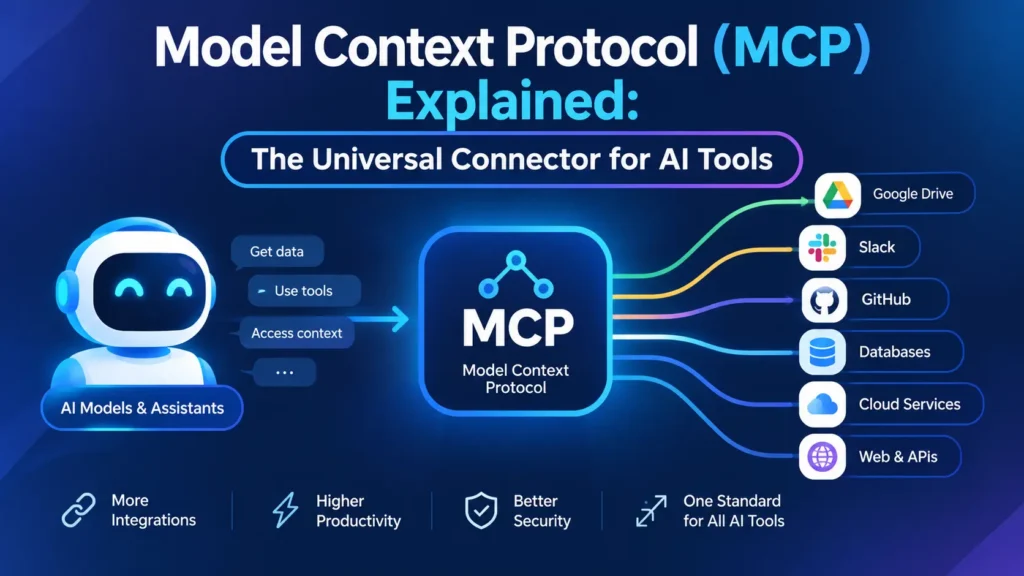
Model Context Protocol (MCP) Explained. Imagine giving your AI assistant the ability to check your calendar query a database or execute code without writing a single custom integration . That’s the promise of the Model Context Protocol (MCP) an open standard that’s reshaping how large language models connect to the outside world .
If you’ve been following developments in AI agents and tool integration, you’ve likely encountered MCP in technical discussions . But what exactly is it and why should anyone building with AI care ? This guide breaks down MCP in plain English covering everything from its core architecture to practical implementation and the security considerations you need to know .
What Is the Model Context Protocol?
MCP is an open protocol that standardizes how LLM applications connect with external data sources and tools . Think of it as a universal adapter for AI systems instead of building custom connectors for every tool developers can use a single protocol that works across different models and platforms.
The protocol was designed with inspiration from the Language Server Protocol (LSP) which solved a similar problem for programming languages and code editors . Just as LSP lets any code editor work with any programming language MCP lets any compatible AI application work with any MCP server . Model Context Protocol (MCP) Explained.
The Core Problem MCP Solves
Before MCP, connecting an LLM to external tools meant building bespoke integrations . Each connection required its own schema authentication handling and error management . With M applications and N data sources , you’d need M×N custom integrations.
MCP reduces this to M+N . One server per backend system serves any agent that needs it. Changes propagate once and a bug fix in a shared server improves every agent consuming it.
Model Context Protocol (MCP) Explained
The protocol follows a client-server architecture with three main components:
Hosts
Hosts are the LLM applications that initiate connections . Examples include AI powered IDEs, chat interfaces or custom AI workflows . Model Context Protocol (MCP) Explained. The host orchestrates the overall interaction and manages user consent. Model Context Protocol (MCP) Explained . Model Context Protocol (MCP) Explained.
Clients
Clients are connectors within the host application . They maintain connections to individual MCP servers and handle the communication layer. Model Context Protocol (MCP) Explained.
Servers
Servers expose context and capabilities to clients. Each server wraps a specific tool or data source a Google Calendar, a database a code execution environment and makes it available through the standardized protocol.
Key Features: Tools, Resources and Prompts
MCP servers offer three primary feature types that clients can discover and use:
| Feature | Purpose | Example |
|---|---|---|
| Tools | Functions the AI model can execute | Send an email, query a database run code |
| Resources | Context and data for the model or user | File contents, API responses, documentation |
| Prompts | Templated messages and workflows | Reusable instruction sets for common tasks |
The protocol uses JSON RPC 2.0 for communication, with stateless , self contained requests and per request capability negotiation. Model Context Protocol (MCP) Explained.
Extensions for Advanced Use Cases
Beyond the core protocol, MCP defines optional extensions that add specialized functionality :
- Tasks : Asynchronous execution of long running operations with polling and durable handles
- Skills over MCP : Rich, structured instructions for agent workflows
- MCP Apps : Interactive UI elements rendered inline within conversations
Why MCP Matters: Benefits for Developers
Discoverability
Clients ask what tools exist instead of hard coding them. This dynamic discovery means you can add new capabilities without redeploying your AI application.
Swappability
A tool is a server. Replacing it is a configuration change, not a code rewrite . This modularity makes it easy to experiment with different backends or migrate between providers .
Ecosystem Effects
One client can speak to many servers, turning an entire repository’s tools, databases, and services into the same protocol surface . Pre built MCP server catalogs accelerate development further teams pick a server from the catalog instead of writing one from scratch.
Model Diversity
The tool layer stays stable while models change underneath. Teams evaluating multiple providers don’t need separate tool implementations for each model. Model Context Protocol (MCP) Explained.
MCP vs. Function Calling: Understanding the Difference
Function calling and MCP are often confused but they operate at different levels. Function calling is the in process mechanism where a harness declares tool schemas to the model and the model returns a structured call. MCP standardizes the same shape across servers and clients through a tool registry JSON RPC transport and three primitives.
Here’s the practical distinction:
- Function calling wins on day one. No server infrastructure, no deployment workflow . Define a schema, pass it to the API, write the handler. Model Context Protocol (MCP) Explained.
- MCP often wins later as agent count grows. Shared servers reduce per agent integration cost and centralized observability means one place to check when a tool call fails.
Most production platforms use both protocols together. MCP standardizes the contract between agent and tool ; it does not govern what the agent may do with a tool.
Real World Use Cases
A comprehensive analysis of over 177,000 AI agent tools published between November 2024 and February 2026 revealed telling patterns about MCP adoption:
Software Development Dominates
Tools for software development and IT account for 67% of all published MCP tools and 90% of downloads . Most agents today accelerate technical workflows. Model Context Protocol (MCP) Explained.
The Shift Toward Action
Early MCP tools focused on perception reading files, querying data . By late 2025, download patterns shifted toward tools that execute code control computers or interact with external systems . Action enabling tools now represent the majority of use.
Finance Emerges as High Stakes
MCP servers with payment execution capabilities grew from 46 in January 2025 to over 1,200 in January 2026 with notable concentration in cryptocurrency tools enabling direct, potentially irreversible transactions.
AI Building Its Own Tools
AI assistance was detected in 29% of MCP servers . The share of newly created servers with AI assistance rose from 6% in January 2025 to 55% in January 2026 . Claude Code dominated AI-assisted tool creation and accounting for 66% of AI co authored servers.
Security Considerations: The Critical Layer
MCP’s power arbitrary data access and code execution introduces significant security and trust considerations that all implementers must address.
Key Security Principles
User Consent and Control : Users must explicitly consent to and understand all data access and operations. Implementers should provide clear UIs for reviewing and authorizing activities.
Data Privacy : Hosts must obtain explicit user consent before exposing user data to servers and must not transmit resource data elsewhere without user consent. Model Context Protocol (MCP) Explained.
Tool Safety : Tools represent arbitrary code execution and must be treated with appropriate caution. Tool descriptions should be considered untrusted unless obtained from a trusted server.
Common Attack Vectors
Research has identified several MCP specific vulnerabilities:
- Tool Poisoning : Malicious logic embedded into an MCP tool while preserving its legitimate interface. Model Context Protocol (MCP) Explained.
- Indirect Prompt Injection : Malicious instructions hidden in external data sources that the model retrieves through MCP tools
- Credential Theft : API keys stored in plaintext configuration files that can be exfiltrated
- Sandbox Escape : Poorly configured servers running with excessive privileges
A comparative security study across 3,250 test scenarios found that Function Calling showed higher system centric vulnerabilities while MCP exhibited greater LLM centric exposure. Composed attacks linking AI and software vulnerabilities achieved significantly higher success rates than isolated attacks. Model Context Protocol (MCP) Explained.
The MCP spec admits that the protocol in itself won’t ensure security at protocol level ( ” It is not possible to secure the protocol itself.”) Implementers are expected to implement consent and authorisation flows, document any security considerations and otherwise implement correct access control.
Getting Started with MCP: Practical Tips
For Developers Building AI Applications
- Start with a gateway layer. Production deployments need a gateway on top of MCP to enforce governance policies, provide RBAC and maintain audit trails.
- Treat tool outputs as potentially adversarial. Defenses must detect and neutralize harmful instructions hidden in external data streams. Model Context Protocol (MCP) Explained.
- Consider hybrid architectures. Most platforms use both function calling and MCP together, choosing based on scope and governance needs.
For Teams Evaluating MCP Adoption
- Track integration duplication. Once the same integration gets re implemented across teams, the MCP server investment becomes justified.
- Assess governance requirements. Regulated environments and customer facing agents shift the equation toward centralized MCP governance.
- Plan for model diversity. If you expect to switch or evaluate multiple providers, MCP keeps your tool layer stable. Model Context Protocol (MCP) Explained.
Also Check : How to Build a Website: Complete Beginner’s Guide for 2026
Common Mistakes to Avoid
- Assuming MCP solves sandboxing. MCP standardizes the contract between agent and tool; it does not govern what the agent may do with a tool.
- Ignoring consent flows. The protocol requires explicit user consent before invoking any tool, but implementation is the host’s responsibility. Model Context Protocol (MCP) Explained.
- Storing credentials in plaintext. Default configuration files often contain API keys embedded directly in JSON, creating attractive targets for credential stealing attacks.
- Treating discovery as trust. A tool’s presence in a catalog doesn’t guarantee safety. Supply chain compromise through malicious server packages is a documented risk.
Frequently Asked Questions (FAQs)
What does MCP stand for?
MCP stands for Model Context Protocol. It’s an open standard that enables seamless integration between LLM applications and external data sources and tools. Model Context Protocol (MCP) Explained.
Is MCP free to use?
Yes. MCP is an open protocol with a public specification. The reference implementations and SDKs are available for developers to use without licensing fees.
How is MCP different from APIs?
Traditional APIs require custom integration code for each connection . MCP provides a standardized protocol where clients discover tools dynamically and communicate through JSON RPC , reducing the integration burden from M×N to M+N.
Can MCP work with any LLM?
MCP is designed to be model agnostic . The protocol standardizes the tool layer , so the same MCP servers work across different LLM providers and models.
What are MCP servers?
MCP servers are services that provide context and capabilities to AI applications . Each server wraps a specific tool or data source like GitHub, Slack or PostgreSQL and exposes it through the standardized MCP interface.
Is MCP secure?
MCP provides mechanisms for security but doesn’t enforce it at the protocol level. Implementors must build consent flows, access controls, and governance layers . Research has identified risks including prompt injection, credential theft and supply chain attacks.
What’s the difference between MCP and function calling?
Function calling is the in process mechanism for a model to invoke tools . MCP is a protocol that standardizes tool discovery and communication across servers and clients . They’re complementary most production systems use both.
Who created MCP?
The protocol specification is maintained at modelcontextprotocol.io. The specification references a TypeScript schema in the official GitHub repository. Model Context Protocol (MCP) Explained.
What types of tools can MCP servers expose?
MCP servers can expose tools (executable functions) resources (context and data) and prompts (templated workflows) . Extensions add asynchronous tasks, structured skills, and interactive UI elements.
Is MCP ready for production?
MCP is being used in production, particularly in software development and IT workflows . However, organizations should implement gateway layers for governance, maintain audit trails and treat tool outputs as potentially adversarial.
Final Thoughts
The Model Context Protocol is an important step toward a more composable AI ecosystem. MCP simplifies the process of modeling tool and data connectivity, allowing for an ecosystem of shared, reusable capabilities. Model Context Protocol (MCP) Explained.
The protocol doesn’t solve everything, security, governance, sandboxing are still implementation problems. But if you’re building AI agents that need to connect to the world, MCP is a nice discovery driven, flexible way to add tools.
It’s a simple story : agent tooling is exploding, and action enablers are in use. By following MCP today, you will be ahead of the curve as the ecosystem builds. Model Context Protocol (MCP) Explained.
What have been your thoughts on MCP? Do you develop MCP servers or use them in your applications? Leave your comments down below and if you enjoyed reading this article, then please do share it with other would be AI agent creators!

One Comment